Minimum-cost flow problem
Mathematical optimization problem
The minimum-cost flow problem (MCFP) is an optimization and decision problem to find the cheapest possible way of sending a certain amount of flow through a flow network. A typical application of this problem involves finding the best delivery route from a factory to a warehouse where the road network has some capacity and cost associated. The minimum cost flow problem is one of the most fundamental among all flow and circulation problems because most other such problems can be cast as a minimum cost flow problem and also that it can be solved efficiently using the network simplex algorithm.
01Definition
A flow network is a directed graph 





The definition of the problem is to minimize the total cost of the flow over all edges:
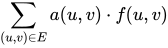
with the constraints
Capacity constraints: Skew symmetry: Flow conservation: Required flow:





02Relation to other problems
A variation of this problem is to find a flow which is maximum, but has the lowest cost among the maximum flow solutions. This could be called a minimum-cost maximum-flow problem and is useful for finding minimum cost maximum matchings.
With some solutions, finding the minimum cost maximum flow instead is straightforward. If not, one can find the maximum flow by performing a binary search on
A related problem is the minimum cost circulation problem, which can be used for solving minimum cost flow. The minimum cost circulation problem has no source and sink; instead it has costs and lower and upper bounds on each edge, and seeks flow amounts within the given bounds that balance the flow at each vertex and minimize the sum over edges of cost times flow. Any minimum-cost flow instance can be converted into a minimum cost circulation instance by setting the lower bound on all edges to zero, and then making an extra edge from the sink 

The following problems are special cases of the minimum cost flow problem (we provide brief sketches of each applicable reduction, in turn):
- Shortest path problem (single-source). Require that a feasible solution to the minimum cost flow problem sends one unit of flow from a designated source
- Maximum flow problem. Choose a large demand
- Assignment problem. Suppose that each partite set in the bipartition has
vertices, and denote the bipartition by
. Give each
supply
and give each
demand
03Solutions
The minimum cost flow problem can be solved by linear programming, since we optimize a linear function, and all constraints are linear.
Apart from that, many combinatorial algorithms exist. Some of them are generalizations of maximum flow algorithms, others use entirely different approaches.
Well-known fundamental algorithms (they have many variations):
- Cycle canceling: a general primal method.
- Cut canceling: a general dual method.
- Minimum mean cycle canceling: a simple strongly polynomial algorithm.
- Successive shortest path and capacity scaling: dual methods, which can be viewed as the generalization of the Ford-Fulkerson algorithm.
- Cost scaling: a primal-dual approach, which can be viewed as the generalization of the push-relabel algorithm.
- Network simplex algorithm: a specialized version of the linear programming simplex method.
- Out-of-kilter algorithm by D. R. Fulkerson
Cycle canceling algorithms
These algorithms are iterative and like the Ford-Fulkerson algorithm they define a residual graph. If there is flow 


Almost-linear time algorithm
A deterministic almost-linear time algorithm is known to solve the minimum-cost flow problem on directed graphs. That is, on a graph with 

04Application
Minimum weight bipartite matching
Given a bipartite graph G = (A ∪ B, E), the goal is to find the maximum cardinality matching in G that has minimum cost. Let w: E → R be a weight function on the edges of E. The minimum weight bipartite matching problem or assignment problem is to find a perfect matching M ⊆ E whose total weight is minimized. The idea is to reduce this problem to a network flow problem.
Let G′ = (V′ = A ∪ B, E′ = E). Assign the capacity of all the edges in E′ to 1. Add a source vertex s and connect it to all the vertices in A′ and add a sink vertex t and connect all vertices inside group B′ to this vertex. The capacity of all the new edges is 1 and their costs is 0. It is proved that there is minimum weight perfect bipartite matching in G if and only if there a minimum cost flow in G′.
Sources and credits
This article is adapted from the Wikipedia article “Minimum-cost flow problem”, written by its contributors and licensed under CC BY-SA 4.0. Fathomly has changed the layout, removed citation markers, navigation and maintenance notices, and adjusted punctuation. This adapted version is shared under the same license. For references, see the original article.
Images, from Wikimedia Commons:
- Minimum weight bipartite matching.pdf by Arash.nouri, CC BY-SA 3.0
Fathomly is not affiliated with or endorsed by the Wikimedia Foundation. Spotted a problem? Tell us.