Cauchy-continuous function
In mathematics, a Cauchy-continuous, or Cauchy-regular, function is a special kind of continuous function between metric spaces (or more general spaces). Cauchy-continuous functions have the useful property that they can always be (uniquely) extended to the Cauchy completion of their domain.
01Definition
Let and
be metric spaces, and let
be a function from
to
Then
is Cauchy-continuous if and only if, given any Cauchy sequence
in
the sequence
is a Cauchy sequence in
02Properties
Every uniformly continuous function is also Cauchy-continuous. Conversely, if the domain is totally bounded, then every Cauchy-continuous function is uniformly continuous. More generally, even if
is not totally bounded, a function on
is Cauchy-continuous if and only if it is uniformly continuous on every totally bounded subset of
Every Cauchy-continuous function is continuous. Conversely, if the domain is complete, then every continuous function is Cauchy-continuous. More generally, even if
is not complete, as long as
is complete, then any Cauchy-continuous function from
to
can be extended to a continuous (and hence Cauchy-continuous) function defined on the Cauchy completion of
this extension is necessarily unique.
Combining these facts, if is compact, then continuous maps, Cauchy-continuous maps, and uniformly continuous maps on
are all the same.
03Examples and non-examples
Since the real line is complete, continuous functions on
are Cauchy-continuous. On the subspace
of rational numbers, however, matters are different. For example, define a two-valued function so that
is
when
is less than
but
when
is greater than
(Note that
is never equal to
for any rational number
) This function is continuous on
but not Cauchy-continuous, since it cannot be extended continuously to
On the other hand, any uniformly continuous function on
must be Cauchy-continuous. For a non-uniform example on
let
be
; this is not uniformly continuous (on all of
), but it is Cauchy-continuous. (This example works equally well on
)
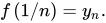
A Cauchy sequence in
can be identified with a Cauchy-continuous function from
to
defined by
If
is complete, then this can be extended to
will be the limit of the Cauchy sequence.
04Generalizations
Cauchy continuity makes sense in situations more general than metric spaces, but then one must move from sequences to nets (or equivalently filters). The definition above applies, as long as the Cauchy sequence is replaced with an arbitrary Cauchy net. Equivalently, a function
is Cauchy-continuous if and only if, given any Cauchy filter
on
then
is a Cauchy filter base on
This definition agrees with the above on metric spaces, but it also works for uniform spaces and, most generally, for Cauchy spaces.
Any directed set may be made into a Cauchy space. Then given any space
the Cauchy nets in
indexed by
are the same as the Cauchy-continuous functions from
to
If
is complete, then the extension of the function to
will give the value of the limit of the net. (This generalizes the example of sequences above, where 0 is to be interpreted as
)
Sources and credits
This article is adapted from the Wikipedia article “Cauchy-continuous function”, written by its contributors and licensed under CC BY-SA 4.0. Fathomly has changed the layout, removed citation markers, navigation and maintenance notices, and adjusted punctuation. This adapted version is shared under the same license. For references, see the original article.
Fathomly is not affiliated with or endorsed by the Wikimedia Foundation. Spotted a problem? Tell us.