Cage (graph theory)
Regular graph with fewest possible nodes for its girth

In the mathematical field of graph theory, a cage is a regular graph that has as few vertices as possible for its girth.
Formally, an (r, g)-graph is defined to be a graph in which each vertex has exactly r neighbors, and in which the shortest cycle has a length of exactly g. An (r, g)-cage is an (r, g)-graph with the smallest possible number of vertices, among all (r, g)-graphs. A (3, g)-cage is often called a g-cage.
It is known that an (r, g)-graph exists for any combination of r ≥ 2 and g ≥ 3. It follows that all (r, g)-cages exist.
If a Moore graph exists with degree r and girth g, it must be a cage. Moreover, the bounds on the sizes of Moore graphs generalize to cages: any cage with odd girth g must have at least
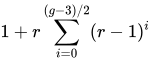
vertices, and any cage with even girth g must have at least
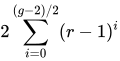
vertices. Any (r, g)-graph with exactly this many vertices is by definition a Moore graph and therefore automatically a cage.
There may exist multiple cages for a given combination of r and g. For instance there are three non-isomorphic (3, 10)-cages, each with 70 vertices: the Balaban 10-cage, the Harries graph and the Harries-Wong graph. But there is only one (3, 11)-cage: the Balaban 11-cage (with 112 vertices).
01Known cages
A 1-regular graph has no cycle, and a connected 2-regular graph has girth equal to its number of vertices, so cages are only of interest for r ≥ 3. The (r,3)-cage is a complete graph Kr+1 on r + 1 vertices, and the (r,4)-cage is a complete bipartite graph Kr,r on 2r vertices.
Notable cages include:
- (3,5)-cage: the Petersen graph, 10 vertices
- (3,6)-cage: the Heawood graph, 14 vertices
- (3,7)-cage: the McGee graph, 24 vertices
- (3,8)-cage: the Tutte-Coxeter graph, 30 vertices
- (3,10)-cage: the Balaban 10-cage, 70 vertices
- (3,11)-cage: the Balaban 11-cage, 112 vertices
- (3,12)-cage: the Tutte 12-cage, 126 vertices
- (4,5)-cage: the Robertson graph, 19 vertices
- (7,5)-cage: The Hoffman-Singleton graph, 50 vertices.
- When r − 1 is a prime power, the (r,6) cages are the incidence graphs of projective planes.
- When r − 1 is a prime power, the (r,8) and (r,12) cages are generalized polygons.
The numbers of vertices in the known (r,g) cages, for values of r > 2 and g > 2, other than projective planes and generalized polygons, are:
| g r | 3 | 4 | 5 | 6 | 7 | 8 | 9 | 10 | 11 | 12 |
|---|---|---|---|---|---|---|---|---|---|---|
| 3 | 4 | 6 | 10 | 14 | 24 | 30 | 58 | 70 | 112 | 126 |
| 4 | 5 | 8 | 19 | 26 | 67 | 80 | 728 | |||
| 5 | 6 | 10 | 30 | 42 | 170 | 2730 | ||||
| 6 | 7 | 12 | 40 | 62 | 312 | 7812 | ||||
| 7 | 8 | 14 | 50 | 90 |
02Asymptotics
For large values of g, the Moore bound implies that the number n of vertices must grow at least exponentially as a function of g. Equivalently, g can be at most proportional to the logarithm of n. More precisely,

It is believed that this bound is tight or close to tight (Bollobás & Szemerédi 2002). The best known lower bounds on g are also logarithmic, but with a smaller constant factor (implying that n grows exponentially but at a higher rate than the Moore bound). Specifically, the construction of Ramanujan graphs defined by Lubotzky, Phillips & Sarnak (1988) satisfy the bound
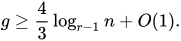
This bound was improved slightly by Lazebnik, Ustimenko & Woldar (1995).
It is unlikely that these graphs are themselves cages, but their existence gives an upper bound to the number of vertices needed in a cage.
Sources and credits
This article is adapted from the Wikipedia article “Cage (graph theory)”, written by its contributors and licensed under CC BY-SA 4.0. Fathomly has changed the layout, removed citation markers, navigation and maintenance notices, and adjusted punctuation. This adapted version is shared under the same license. For references, see the original article.
Images, from Wikimedia Commons:
- Tutte eight cage.svg by Unknown author, Public domain
Fathomly is not affiliated with or endorsed by the Wikimedia Foundation. Spotted a problem? Tell us.