Butler-Volmer equation
Equation characterising electrochemical kinetics
In electrochemistry, the Butler-Volmer equation (named after John Alfred Valentine Butler and Max Volmer), also known as Erdey-Grúz-Volmer equation (after Tibor Erdey-Grúz), is one of the most fundamental relationships in electrochemical kinetics. It describes how the electrical current through an electrode depends on the voltage difference between the electrode and the bulk electrolyte for a simple, unimolecular redox reaction, considering that both a cathodic and an anodic reaction occur on the same electrode:
01Butler-Volmer equation
The Butler-Volmer equation is:
![j=j_{0}\cdot \left\{\exp \left[{\frac {\alpha _{\rm {a}}zF}{RT}}(E-E_{\rm {eq}})\right]-\exp \left[-{\frac {\alpha _{\rm {c}}zF}{RT}}(E-E_{\rm {eq}})\right]\right\}](https://wikimedia.org/api/rest_v1/media/math/render/svg/f04ada917b1e46ab7d26da3300b2f080d9fd591a)
or in a more compact form:
![j=j_{0}\cdot \left\{\exp \left[{\frac {\alpha _{\rm {a}}zF\eta }{RT}}\right]-\exp \left[-{\frac {\alpha _{\rm {c}}zF\eta }{RT}}\right]\right\}](https://wikimedia.org/api/rest_v1/media/math/render/svg/3ad7b1050149062da030fd2d606ff986928c8529)
where:
: electrode current density, A/m2 (defined as
)
: exchange current density, A/m2
: electrode potential, V
: equilibrium potential, V
: absolute temperature, K
: number of electrons involved in the electrode reaction
: Faraday constant
: universal gas constant
: so-called cathodic charge transfer coefficient, dimensionless
: so-called anodic charge transfer coefficient, dimensionless
: activation overpotential (defined as
).
The right hand figure shows plots valid for 
Limiting cases
There are two limiting cases of the Butler-Volmer equation:
- the low overpotential region (called "polarization resistance", i.e., when E ≈ Eeq), where the Butler-Volmer equation simplifies to:
;
- the high overpotential region, where the Butler-Volmer equation simplifies to the Tafel equation. When
, the first term dominates, and when
, the second term dominates.
for a cathodic reaction, when E << Eeq, or
for an anodic reaction, when E >> Eeq
where 

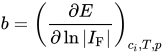
where 


![The upper graph shows the current density as a function of the overpotential η. The anodic and cathodic current densities are shown as ja and jc, respectively for α = αa = αc = 0.5, and j0 = 2</sup>"}},"i":0}}]}' id="mwJw">1 mA/cm2 (close to values for platinum and palladium). The lower graph shows the logarithmic plot for different values of α (Tafel plot).](https://upload.wikimedia.org/wikipedia/commons/thumb/3/3a/Current_density_versus_potential_according_to_butler_volmer_equation.svg/330px-Current_density_versus_potential_according_to_butler_volmer_equation.svg.png)
02Extended Butler-Volmer equation
The more general form of the Butler-Volmer equation, applicable to the mass transfer-influenced conditions, can be written as:
![j=j_{0}\left\{{\frac {c_{\rm {o}}(0,t)}{c_{\rm {o}}^{*}}}\exp \left[{\frac {\alpha _{\rm {a}}zF\eta }{RT}}\right]-{\frac {c_{\rm {r}}(0,t)}{c_{\rm {r}}^{*}}}\exp \left[-{\frac {\alpha _{\rm {c}}zF\eta }{RT}}\right]\right\}](https://wikimedia.org/api/rest_v1/media/math/render/svg/2ba8cdc412ace94d2b8bd614a0c34bf817cca666)
where:
- j is the current density, A/m2,
- co and cr refer to the concentration of the species to be oxidized and to be reduced, respectively,
- c(0,t) is the time-dependent concentration at a distance of zero from the surface of the electrode.
The above form simplifies to the conventional expression (shown at the top of the article) when the concentration of the electroactive species at the surface is equal to that in the bulk. The concentration at the surface of the electrode can differ from the bulk concentration because of the formation of the electrical double layer (EDL) and mass transportation limitations during the reaction.
The effect of the EDL was first formalized by Alexander N. Frumkin and is incorporated in the Frumkin-Butler-Volmer theory. The variation of the electrochemical potential in the vicinity of the electrode surface modifies the local concentration of ionic species, thereby affecting electrochemical reaction involving them.
Mass transportation also influences the reaction rate. There are two rates which determine the current-voltage relationship for an electrode. First is the rate of the chemical reaction at the electrode, which consumes reactants and produces products. This is known as the charge transfer rate. The second is the rate at which reactants are supplied to, and products are removed from, the electrode region via processes such as diffusion, migration, and convection. The latter is known as the mass-transfer rate. These two rates determine the concentrations of the reactants and products at the electrode, which they in turn determine. The slowest of these rates will determine the overall rate of the process.
The simple Butler-Volmer equation assumes that the concentrations at the electrode are approximately equal to those in the bulk electrolyte, allowing the current to be expressed as a function of potential only. In other words, it assumes that the mass-transfer rate is much greater than the reaction rate and that the slower chemical rate dominates the reaction. Despite this limitation, the utility of the Butler-Volmer equation in electrochemistry is wide, and it is often considered to be "central in the phenomenological electrode kinetics".
The extended Butler-Volmer equation does not make this assumption; instead, it treats the concentrations at the electrode as given, yielding a relationship in which the current is expressed as a function not only of potential but also of the given concentrations. The mass-transfer rate may be relatively low, but its only effect on the chemical reaction is through the altered (given) concentrations. In effect, the concentrations are also a function of the potential. A full treatment, which yields the current as a function of potential only, will be expressed by the extended Butler-Volmer equation, but will require explicit inclusion of mass-transfer effects to express the concentrations as functions of the potential.
Derivation
General expression
The following derivation of the extended Butler-Volmer equation is adapted from that of Bard and Faulkner and Newman and Thomas-Alyea. For a simple unimolecular, one-step redox reaction of the form:
- O + n e− → R
The forward and backward reaction rates (vf and vb) and, from Faraday's laws of electrolysis, the associated electrical current densities (j), may be written as:


where kf and kb are the reaction rate constants, with units of frequency (1/time) and co and cr are the surface concentrations (mol/area) of the oxidized and reduced molecules, respectively (written as co(0,t) and cr(0,t) in the previous section). The net rate of reaction v and net current density j are then:

The figure above plots various Gibbs energy curves as a function of the reaction coordinate ξ. The reaction coordinate is approximately a measure of distance, with the electrode body on the left and the bulk solution on the right. The blue energy curve shows the increase in Gibbs energy of an oxidized molecule as it moves toward the electrode surface in the absence of an applied potential. The black energy curve shows the increase in Gibbs energy as a reduced molecule moves closer to the electrode. The two energy curves intersect at 


Assume that the rate constants are well approximated by an Arrhenius equation,
![k_{f}=A_{f}\exp[-\Delta ^{\ddagger }G_{c}/RT]](https://wikimedia.org/api/rest_v1/media/math/render/svg/6665dbea2e1416b14eb890d7a632af7a69489c4c)
![k_{b}=A_{b}\exp[-\Delta ^{\ddagger }G_{a}/RT]](https://wikimedia.org/api/rest_v1/media/math/render/svg/1b67f5c14cbc2f6dfa84ecae9c8c4cf62dfd96a9)
where the Af and Ab are constants such that Af co = Ab cr is the "correctly oriented" O-R collision frequency. The exponential term (Boltzmann factor) is the fraction of those collisions with sufficient energy to overcome the barrier and react.
Assuming that the energy curves are practically linear in the transition region, they may be represented there by:
(blue curve) (red curve) (black curve)



The charge transfer coefficient for this simple case is equivalent to the symmetry factor, and can be expressed in terms of the slopes of the energy curves:

It follows that:


For conciseness, define:



The rate constants can now be expressed as:
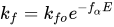
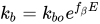
where the rate constants at zero potential are:


The current density j as a function of applied potential E may now be written:

Expression in terms of the equilibrium potential
At a certain voltage Ee, equilibrium will be attained and the forward and backward rates (vf and vb) will be equal. The green curve in the above figure represents this. The equilibrium rate constants will be written as kfe and kbe, and the equilibrium concentrations will be written coe and cre. The equilibrium currents (jce and jae) will be equal and are written as jo, which is known as the exchange current density.


Note that the net current density at equilibrium will be zero. The equilibrium rate constants are then:
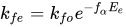
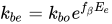
Solving the above for kfo and kbo in terms of the equilibrium concentrations coe and cre and the exchange current density jo, the current density j as a function of applied potential E may now be written:

Assuming that equilibrium holds in the bulk solution, with concentrations 


Expression in terms of the formal potential
For the simple reaction, the change in Gibbs energy is:

where aoe and are are the activities at equilibrium. The activities a are related to the concentrations c by a = γc, where γ is the activity coefficient. The equilibrium potential is given by the Nernst equation:

where 

Defining the formal potential:

The equilibrium potential is then:

Substituting this equilibrium potential into the Butler-Volmer equation yields:

which may also be written in terms of the standard rate constant ko as:

The standard rate constant is an essential descriptor of electrode behavior, independent of concentrations. It is a measure of the rate at which the system will approach equilibrium. In the limit as 


Sources and credits
This article is adapted from the Wikipedia article “Butler-Volmer equation”, written by its contributors and licensed under CC BY-SA 4.0. Fathomly has changed the layout, removed citation markers, navigation and maintenance notices, and adjusted punctuation. This adapted version is shared under the same license. For references, see the original article.
Images, from Wikimedia Commons:
- Current density versus potential according to butler volmer equation.svg by Toshiyouri, CC BY-SA 4.0
- ButlerVolmerGibbsPlot.png by PAR, CC0
Fathomly is not affiliated with or endorsed by the Wikimedia Foundation. Spotted a problem? Tell us.
