Björling problem
Problem in differential geometry

In differential geometry, the Björling problem is the problem of finding a minimal surface passing through a given curve with prescribed normal (or tangent planes). The problem was posed and solved by Swedish mathematician Emanuel Gabriel Björling, with further refinement by Hermann Schwarz.
The problem can be solved by extending the surface from the curve using complex analytic continuation. If 


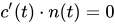

where 


A classic example is Catalan's minimal surface, which passes through a cycloid curve. Applying the method to a semicubical parabola produces the Henneberg surface, and to a circle (with a suitably twisted normal field) a minimal Möbius strip.
A unique solution always exists. It can be viewed as a Cauchy problem for minimal surfaces, allowing one to find a surface if a geodesic, asymptote or lines of curvature is known. In particular, if the curve is planar and geodesic, then the plane of the curve will be a symmetry plane of the surface.
01External image galleries
- Björling Surfaces, at the Indiana Minimal Surface Archive: http://www.indiana.edu/~minimal/archive/Bjoerling/index.html
Sources and credits
This article is adapted from the Wikipedia article “Björling problem”, written by its contributors and licensed under CC BY-SA 4.0. Fathomly has changed the layout, removed citation markers, navigation and maintenance notices, and adjusted punctuation. This adapted version is shared under the same license. For references, see the original article.
Images, from Wikimedia Commons:
- Catalan's Minimal Surface.png by Anders Sandberg, CC BY-SA 3.0
Fathomly is not affiliated with or endorsed by the Wikimedia Foundation. Spotted a problem? Tell us.