Cauchy problem
Class of problems for PDEs
A Cauchy problem in mathematics asks for the solution of a partial differential equation that satisfies certain conditions that are given on a hypersurface in the domain. A Cauchy problem may involve initial or boundary values. It is named after Augustin-Louis Cauchy.
01Formal statement
For a partial differential equation defined on 





where 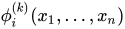
02Cauchy-Kowalevski theorem
The Cauchy-Kovalevskaya theorem, named in honor of Cauchy and Sofya Kovalevskaya, states: If all the functions 


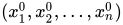

Sources and credits
This article is adapted from the Wikipedia article “Cauchy problem”, written by its contributors and licensed under CC BY-SA 4.0. Fathomly has changed the layout, removed citation markers, navigation and maintenance notices, and adjusted punctuation. This adapted version is shared under the same license. For references, see the original article.
Fathomly is not affiliated with or endorsed by the Wikimedia Foundation. Spotted a problem? Tell us.