Binomial process
A binomial process is a special point process in probability theory.
01Definition
Let 




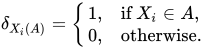
Then the binomial process based on n and P is the random measure

where
02Properties
Name
The name of a binomial process is derived from the fact that for all measurable sets 



Laplace-transform
The Laplace transform of a binomial process is given by
![{\mathcal {L}}_{P,n}(f)=\left[\int \exp(-f(x))\mathrm {P} (dx)\right]^{n}](https://wikimedia.org/api/rest_v1/media/math/render/svg/83b07eff25e85fe781764d51273e3930676a6cd5)
for all positive measurable functions 
Intensity measure
The intensity measure 


03Generalizations
A generalization of binomial processes are mixed binomial processes. In these point processes, the number of points is not deterministic like it is with binomial processes, but is determined by a random variable 

04Literature
- Kallenberg, Olav (2017). Random Measures, Theory and Applications. Switzerland: Springer. doi:10.1007/978-3-319-41598-7. ISBN 978-3-319-41596-3.
Sources and credits
This article is adapted from the Wikipedia article “Binomial process”, written by its contributors and licensed under CC BY-SA 4.0. Fathomly has changed the layout, removed citation markers, navigation and maintenance notices, and adjusted punctuation. This adapted version is shared under the same license. For references, see the original article.
Fathomly is not affiliated with or endorsed by the Wikimedia Foundation. Spotted a problem? Tell us.