Binary operation
Mathematical operation with two operands

In mathematics, a binary operation or dyadic operation is a kind of binary function, i.e. given a pair of input values (called operands), it produces an output value. For example, addition is a binary operation: 
Some definitions require the two inputs and the output to be elements of the same set.
Binary operations are usually written using infix notation such as 

In abstract algebra, a binary operation on a set 


If the mapping is total, 

A binary operation 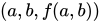


Binary operations are the keystone of most structures that are studied in algebra, in particular in semigroups, monoids, groups, rings, fields, and vector spaces.
01Examples
Arithmetic operations like addition (


Union (


If a broad definition of "binary operation" is used, such that the inputs and output do not have to be from the same set, then scalar multiplication (

Function composition (
02Properties
Ways to classify binary operations include:
- The commutative property:
- The associative property:
- Having an identity element
:
- Each element of
- Each element of




Sources and credits
This article is adapted from the Wikipedia article “Binary operation”, written by its contributors and licensed under CC BY-SA 4.0. Fathomly has changed the layout, removed citation markers, navigation and maintenance notices, and adjusted punctuation. This adapted version is shared under the same license. For references, see the original article.
Images, from Wikimedia Commons:
- Binary operations as black box.svg by Talonnn, CC0
Fathomly is not affiliated with or endorsed by the Wikimedia Foundation. Spotted a problem? Tell us.