Iterated binary operation
Repeated application of an operation to a sequence
In mathematics, an iterated binary operation is an extension of a binary operation on a set S to a function on finite sequences of elements of S through repeated application. Common examples include the extension of the addition operation to the summation operation, and the extension of the multiplication operation to the product operation. Other operations, e.g., the set-theoretic operations union and intersection, are also often iterated, but the iterations are not given separate names. In print, summation and product are represented by special symbols; but other iterated operators often are denoted by larger variants of the symbol for the ordinary binary operator. Thus, the iterations of the four operations mentioned above are denoted
and
, respectively.
More generally, iteration of a binary function is generally denoted by a slash: iteration of 
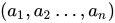

In general, there is more than one way to extend a binary operation to operate on finite sequences, depending on whether the operator is associative, and whether the operator has identity elements.
01Definition
Denote by aj,k, with j ≥ 0 and k ≥ j, the finite sequence of length k − j of elements of S, with members (ai), for j ≤ i < k. Note that if k = j, the sequence is empty.
For f : S × S → S, define a new function Fl on finite nonempty sequences of elements of S, where

Similarly, define

If f has a unique left identity e, the definition of Fl can be modified to operate on empty sequences by defining the value of Fl on an empty sequence to be e (the previous base case on sequences of length 1 becomes redundant). Similarly, Fr can be modified to operate on empty sequences if f has a unique right identity.
If f is associative, then Fl equals Fr, and we can simply write F. Moreover, if an identity element e exists, then it is unique (see Monoid).
If f is commutative and associative, then F can operate on any non-empty finite multiset by applying it to an arbitrary enumeration of the multiset. If f moreover has an identity element e, then this is defined to be the value of F on an empty multiset. If f is idempotent, then the above definitions can be extended to finite sets.
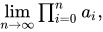
If S also is equipped with a metric or more generally with topology that is Hausdorff, so that the concept of a limit of a sequence is defined in S, then an infinite iteration on a countable sequence in S is defined exactly when the corresponding sequence of finite iterations converges. Thus, e.g., if a0, a1, a2, a3, … is an infinite sequence of real numbers, then the infinite product 
02Non-associative binary operation
The general, non-associative binary operation is given by a magma. The act of iterating on a non-associative binary operation may be represented as a binary tree.
03Basic iterated operations
| Area of mathematics | Sum | Product | ||||||
|---|---|---|---|---|---|---|---|---|
| Name | Operation | Definition | Symbol | Name | Operation | Definition | Symbol | |
| Arithmetic | Summation | Addition | Sum of numbers |  |
Iterated product | Multiplication | Product of numbers |  |
| Set theory | Union of a sequence of sets | Set union | All elements of sets |  |
Intersection of a sequence of sets | Set intersection | Common elements | |
| Logic | Existential quantifier | Disjunction | Disjunction of statements |  |
Universal quantifier | Conjunction | Conjunction of statements |  |
| Divisibility theory | Least common multiple | Least common multiple | The smallest number that is a multiple of all the terms |  |
Greatest common divisor | Greatest common divisor | The greatest number that is a divisor of all the terms |  |
| Category theory | Coproduct | Disjoint union | Coproduct of objects |  |
Product | Cartesian product | Product of objects | |
04Notation
The iterated binary operation is written as:

Meaning of symbols:
| Symbol | Meaning |
|---|---|
 | Iterated binary operation symbol |
 | Index variable |
 | Lower bound |
 or or  | Upper bound |
 | k-th element |
Example:

General form:

Restricted form:

Infinite version:

05Properties
Let 

- Single element:

- Expansion:

- Recursion:

- Right recursion:

- Splitting:

- Permutation invariance:

- Empty product (monoid):

- Idempotence:
- if
, then

- Constant sequence:

06Identity element and empty set
If 
- Empty product = identity element
- Empty sum = 0 (in arithmetic monoids)
07Computer science
Sources and credits
This article is adapted from the Wikipedia article “Iterated binary operation”, written by its contributors and licensed under CC BY-SA 4.0. Fathomly has changed the layout, removed citation markers, navigation and maintenance notices, and adjusted punctuation. This adapted version is shared under the same license. For references, see the original article.
Fathomly is not affiliated with or endorsed by the Wikimedia Foundation. Spotted a problem? Tell us.
