Beta function
Mathematical function

In mathematics, the beta function, also called the Euler integral of the first kind, is a special function that is closely related to the gamma function and to binomial coefficients. It is defined by the integral

where 


The beta function was studied by Leonhard Euler and Adrien-Marie Legendre and was given its name by Jacques Binet; its symbol 
01Properties
The beta function is symmetric, meaning that



A key property of the beta function is its close relationship to the gamma function:
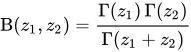
Proof of the relation
Write the product of two factorials as integrals. Since they are integrals in two separate variables, we can combine them into an iterated integral:
![{\begin{aligned}\Gamma (z_{1})\Gamma (z_{2})&=\int _{u=0}^{\infty }\ e^{-u}u^{z_{1}-1}\,du\cdot \int _{v=0}^{\infty }\ e^{-v}v^{z_{2}-1}\,dv\\[6pt]&=\int _{v=0}^{\infty }\int _{u=0}^{\infty }\ e^{-u-v}u^{z_{1}-1}v^{z_{2}-1}\,du\,dv.\end{aligned}}](https://wikimedia.org/api/rest_v1/media/math/render/svg/0602e0665bdaf2c38b4056fa812ae684ba773b53)
Changing variables by 


![{\begin{aligned}\Gamma (z_{1})\Gamma (z_{2})&=\int _{s=0}^{\infty }\int _{t=0}^{1}e^{-s}(st)^{z_{1}-1}(s(1-t))^{z_{2}-1}s\,dt\,ds\\[6pt]&=\int _{s=0}^{\infty }e^{-s}s^{z_{1}+z_{2}-1}\,ds\cdot \int _{t=0}^{1}t^{z_{1}-1}(1-t)^{z_{2}-1}\,dt\\[1ex]&=\Gamma (z_{1}+z_{2})\cdot \mathrm {B} (z_{1},z_{2}).\end{aligned}}](https://wikimedia.org/api/rest_v1/media/math/render/svg/1b141f671e9f67f3d213a8020a0d2a515646924b)
Dividing both sides by 

The stated identity may be seen as a particular case of the identity for the integral of a convolution. Taking

one has:

See The Gamma Function, page 18-19 for a derivation of this relation.
The beta function is also closely related to binomial coefficients. When 


02Derivative


 denotes the
 03Approximation
Stirling's approximation gives the asymptotic formula

for large 

If on the other hand

04Other identities and formulas
The integral defining the beta function may be rewritten in a variety of ways, including the following:
![{\begin{aligned}\mathrm {B} (z_{1},z_{2})&=2\int _{0}^{\pi /2}(\sin \theta )^{2z_{1}-1}(\cos \theta )^{2z_{2}-1}\,d\theta ,\\[6pt]&=\int _{0}^{\infty }{\frac {t^{z_{1}-1}}{(1+t)^{z_{1}+z_{2}}}}\,dt,\\[6pt]&=n\int _{0}^{1}t^{nz_{1}-1}(1-t^{n})^{z_{2}-1}\,dt,\\&=(1-a)^{z_{2}}\int _{0}^{1}{\frac {(1-t)^{z_{1}-1}t^{z_{2}-1}}{(1-at)^{z_{1}+z_{2}}}}dt\qquad {\text{for any }}a\in \mathbb {R} _{\leq 1},\end{aligned}}](https://wikimedia.org/api/rest_v1/media/math/render/svg/0163d50bcc0f2359f68f9ac5acc1fccbf45a262f)
where in the second-to-last identity 
For values 
![\mathrm {B} (z,z)={\frac {1}{z}}\int _{0}^{\pi /2}{\frac {1}{\left({\sqrt[{z}]{\sin \theta }}+{\sqrt[{z}]{\cos \theta }}\right)^{2z}}}\,d\theta .](https://wikimedia.org/api/rest_v1/media/math/render/svg/16a6265c888b98d196d0aa028e51c6ff5b3046e4)
The beta function can be written as an infinite sum:

If

where 

The beta function satisfies several identities analogous to corresponding identities for binomial coefficients, including a version of Pascal's identity

which can be proved as follows:
![{\begin{aligned}\mathrm {B} (x,y+1)+\mathrm {B} (x+1,y)&={\frac {\Gamma (x)\Gamma (y+1)}{\Gamma (x+y+1)}}+{\frac {\Gamma (x+1)\Gamma (y)}{\Gamma (x+y+1)}}\\[5pt]&={\frac {y\Gamma (x)\Gamma (y)+x\Gamma (x)\Gamma (y)}{(x+y)\Gamma (x+y)}}\\[5pt]&={\frac {\Gamma (x)\Gamma (y)}{\Gamma (x+y)}}=\mathrm {B} (x,y).\end{aligned}}](https://wikimedia.org/api/rest_v1/media/math/render/svg/90c6f5cdb74a6cd9ed65797b52d194cac7b5592d)
The above proof also shows the simple recurrence on one coordinate

The positive integer values of the beta function are also the partial derivatives of the function
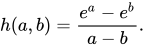
Indeed, for all nonnegative integers

The Pascal-like identity above implies that this function is a solution to the first-order partial differential equation

For 


Evaluation at particular points simplifies the expression significantly; for example,

and

By taking 
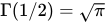

Also, by the Legendre duplication formula, we get

Euler's integral for the beta function may be converted into an integral over the Pochhammer contour 

This Pochhammer contour integral converges for all values of 

Just as the gamma function for integers describes factorials, the beta function can define a binomial coefficient after adjusting indices:

Moreover, for integer 

05Reciprocal beta function
The reciprocal beta function is the function
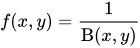
Interestingly, their integral representations closely relate as the definite integral of trigonometric functions with product of its power and multiple-angle:
![{\begin{aligned}\int _{0}^{\pi }\sin ^{x-1}\theta \sin y\theta ~d\theta &={\frac {\pi \sin {\frac {y\pi }{2}}}{2^{x-1}x\mathrm {B} {\left({\frac {x+y+1}{2}},{\frac {x-y+1}{2}}\right)}}},\\[1ex]\int _{0}^{\pi }\sin ^{x-1}\theta \cos y\theta ~d\theta &={\frac {\pi \cos {\frac {y\pi }{2}}}{2^{x-1}x\mathrm {B} {\left({\frac {x+y+1}{2}},{\frac {x-y+1}{2}}\right)}}},\\[1ex]\int _{0}^{\frac {\pi }{2}}\cos ^{x-1}\theta \cos y\theta ~d\theta &={\frac {\pi }{2^{x}x\mathrm {B} {\left({\frac {x+y+1}{2}},{\frac {x-y+1}{2}}\right)}}}.\end{aligned}}](https://wikimedia.org/api/rest_v1/media/math/render/svg/7acbda3e23fb81c921ab77504931f0d56cb4a4bd)
06Incomplete beta function
The incomplete beta function, a generalization of the beta function, is defined as

For 


Substituting 


The regularized incomplete beta function (or regularized beta function for short) is defined in terms of the incomplete beta function and the complete beta function:
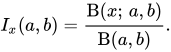
The regularized incomplete beta function is the cumulative distribution function of the beta distribution, and is related to the cumulative distribution function 



Properties

Continued fraction expansion
The continued fraction expansion is

with odd and even coefficients given by
![{\begin{aligned}{d}_{2m+1}&=-{\frac {(a+m)(a+b+m)x}{(a+2m)(a+2m+1)}},\\[1ex]{d}_{2m}&={\frac {m(b-m)x}{(a+2m-1)(a+2m)}}.\end{aligned}}](https://wikimedia.org/api/rest_v1/media/math/render/svg/93c3c4577f493a0b6ddea6e1ce4043999c70f3ba)
The 


It converges rapidly for 



07Multivariate beta function
The beta function can be extended to a function with more than two arguments:

This multivariate beta function is used in the definition of the Dirichlet distribution. Its relationship to the beta function is analogous to the relationship between multinomial coefficients and binomial coefficients. For example, it satisfies a similar version of Pascal's identity:

08Applications
The beta function is useful in computing and representing the scattering amplitude for Regge trajectories. Furthermore, it was the first known scattering amplitude in string theory, first conjectured by Gabriele Veneziano. It also occurs in the theory of the preferential attachment process, a type of stochastic urn process. The beta function is also important in statistics, e.g. for the beta distribution and beta prime distribution.
09Software implementation
Even if unavailable directly, the complete and incomplete beta function values can be calculated using functions commonly included in spreadsheet or computer algebra systems.
In Microsoft Excel, for example, the complete beta function can be computed with the GammaLn function (or special.gammaln in Python's SciPy package):
- Value = Exp(GammaLn(a) + GammaLn(b) − GammaLn(a + b))
This result follows from the properties listed above.
The incomplete beta function cannot be directly computed using such relations and other methods must be used. In GNU Octave, it is computed using a continued fraction expansion.
The incomplete beta function has existing implementation in common languages. For instance, betainc (incomplete beta function) in MATLAB and GNU Octave, pbeta (probability of beta distribution) in R and betainc in SymPy. In SciPy, special.betainc computes the regularized incomplete beta function, which is, in fact, the cumulative beta distribution. To get the actual incomplete beta function, one can multiply the result of special.betainc by the result returned by the corresponding beta function. In Mathematica, Beta[x, a, b] and BetaRegularized[x, a, b] give 
Sources and credits
This article is adapted from the Wikipedia article “Beta function”, written by its contributors and licensed under CC BY-SA 4.0. Fathomly has changed the layout, removed citation markers, navigation and maintenance notices, and adjusted punctuation. This adapted version is shared under the same license. For references, see the original article.
Images, from Wikimedia Commons:
- Beta function.svg by Nschloe, CC BY-SA 4.0
Fathomly is not affiliated with or endorsed by the Wikimedia Foundation. Spotted a problem? Tell us.

