BHT algorithm
Quantum algorithm
In quantum computing, the Brassard-Høyer-Tapp (BHT) algorithm is a quantum algorithm that solves the collision problem. In this problem, one is given n and an 2-to-1 function 


The algorithm was discovered by Gilles Brassard, Peter Høyer, and Alain Tapp in 1997. It uses Grover's algorithm, which was discovered the year before.
01Algorithm
Intuitively, the algorithm combines the square root speedup from the birthday paradox using (classical) randomness with the square root speedup from Grover's (quantum) algorithm.
First, n1/3 inputs to f are selected at random and f is queried at all of them. If there is a collision among these inputs, then we return the colliding pair of inputs. Otherwise, all these inputs map to distinct values by f. Then Grover's algorithm is used to find a new input to f that collides. Since there are n inputs to f and n1/3 of these could form a collision with the already queried values, Grover's algorithm can find a collision with 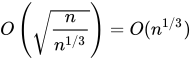
Sources and credits
This article is adapted from the Wikipedia article “BHT algorithm”, written by its contributors and licensed under CC BY-SA 4.0. Fathomly has changed the layout, removed citation markers, navigation and maintenance notices, and adjusted punctuation. This adapted version is shared under the same license. For references, see the original article.
Fathomly is not affiliated with or endorsed by the Wikimedia Foundation. Spotted a problem? Tell us.