Arakelov theory
Mathematical theory
In mathematics, Arakelov theory (or Arakelov geometry) is an approach to Diophantine geometry, named for Suren Arakelov. It is used to study Diophantine equations in higher dimensions.
01Background
The main motivation behind Arakelov geometry is that there is a correspondence between prime ideals 


Note that other techniques exist for constructing a complete space extending
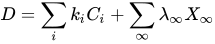
Original definition of divisors
Let 







02Results
Arakelov (1974, 1975) defined an intersection theory on the arithmetic surfaces attached to smooth projective curves over number fields, with the aim of proving certain results, known in the case of function fields, in the case of number fields. Gerd Faltings (1984) extended Arakelov's work by establishing results such as a Riemann-Roch theorem, a Noether formula, a Hodge index theorem and the nonnegativity of the self-intersection of the dualizing sheaf in this context.
Arakelov theory was used by Paul Vojta (1991) to give a new proof of the Mordell conjecture, and by Gerd Faltings (1991) in his proof of Serge Lang's generalization of the Mordell conjecture.
Pierre Deligne (1987) developed a more general framework to define the intersection pairing defined on an arithmetic surface over the spectrum of a ring of integers by Arakelov. Shou-Wu Zhang (1992) developed a theory of positive line bundles and proved a Nakai-Moishezon type theorem for arithmetic surfaces. Further developments in the theory of positive line bundles by Zhang (1993, 1995a, 1995b) and Lucien Szpiro, Emmanuel Ullmo, and Zhang (1997) culminated in a proof of the Bogomolov conjecture by Ullmo (1998) and Zhang (1998).
Arakelov's theory was generalized by Henri Gillet and Christophe Soulé to higher dimensions. That is, Gillet and Soulé defined an intersection pairing on an arithmetic variety. One of the main results of Gillet and Soulé is the arithmetic Riemann-Roch theorem of Gillet & Soulé (1992), an extension of the Grothendieck-Riemann-Roch theorem to arithmetic varieties. For this one defines arithmetic Chow groups CHp(X) of an arithmetic variety X, and defines Chern classes for Hermitian vector bundles over X taking values in the arithmetic Chow groups. The arithmetic Riemann-Roch theorem then describes how the Chern class behaves under pushforward of vector bundles under a proper map of arithmetic varieties. A complete proof of this theorem was only published recently by Gillet, Rössler and Soulé.
Arakelov's intersection theory for arithmetic surfaces was developed further by Jean-Benoît Bost (1999). The theory of Bost is based on the use of Green functions which, up to logarithmic singularities, belong to the Sobolev space 
03Arithmetic Chow groups
An arithmetic cycle of codimension p is a pair (Z, g) where Z ∈ Zp(X) is a p-cycle on X and g is a Green current for Z, a higher-dimensional generalization of a Green function. The arithmetic Chow group 
04The arithmetic Riemann-Roch theorem
The usual Grothendieck-Riemann-Roch theorem describes how the Chern character ch behaves under pushforward of sheaves, and states that ch(f∗(E))= f∗(ch(E)TdX/Y), where f is a proper morphism from X to Y and E is a vector bundle over f. The arithmetic Riemann-Roch theorem is similar, except that the Todd class gets multiplied by a certain power series.
The arithmetic Riemann-Roch theorem states
![{\hat {\mathrm {ch} }}(f_{*}([E]))=f_{*}({\hat {\mathrm {ch} }}(E){\widehat {\mathrm {Td} }}^{R}(T_{X/Y}))](https://wikimedia.org/api/rest_v1/media/math/render/svg/b4983345b315a5a94624d3f4ebb931e5501d47b7)
- X and Y are regular projective arithmetic schemes,
- f is a smooth proper map from X to Y,
- E is an arithmetic vector bundle over X,
is the arithmetic Chern character,
- TX/Y is the relative tangent bundle,
is the arithmetic Todd class,
is
- R(X) is the additive characteristic class associated to the formal power series

![\sum _{m>0 \atop m{\text{ odd}}}{\frac {X^{m}}{m!}}\left[2\zeta '(-m)+\zeta (-m)\left({1 \over 1}+{1 \over 2}+\cdots +{1 \over m}\right)\right].](https://wikimedia.org/api/rest_v1/media/math/render/svg/39aa3cc34a6059301aa48b002f77778a487f9ef5)
Sources and credits
This article is adapted from the Wikipedia article “Arakelov theory”, written by its contributors and licensed under CC BY-SA 4.0. Fathomly has changed the layout, removed citation markers, navigation and maintenance notices, and adjusted punctuation. This adapted version is shared under the same license. For references, see the original article.
Fathomly is not affiliated with or endorsed by the Wikimedia Foundation. Spotted a problem? Tell us.