Arithmetic surface
In mathematics, an arithmetic surface over a Dedekind domain 


Such an object can be defined more formally as an 
01Formal definition
 over a Dedekind domain
  such that
  ; and for other
  in
in  ,
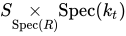
,
 .
.02Over a Dedekind scheme
In even more generality, arithmetic surfaces can be defined over Dedekind schemes, a typical example of which is the spectrum of the ring of integers of a number field (which is the case above). An arithmetic surface is then a regular fibered surface over a Dedekind scheme of dimension one. This generalisation is useful, for example, it allows for base curves which are smooth and projective over finite fields, which is important in positive characteristic.
Over Dedekind rings
Arithmetic surfaces over Dedekind domains are the arithmetic analogue of fibered surfaces over algebraic curves. Arithmetic surfaces arise primarily in the context of number theory. In fact, given a curve 

03Properties
Dimension
Arithmetic surfaces have dimension 2 and relative dimension 1 over their base.
Divisors
We can develop a theory of Weil divisors on arithmetic surfaces since every local ring of dimension one is regular. This is briefly stated as "arithmetic surfaces are regular in codimension one." The theory is developed in Hartshorne's Algebraic Geometry, for example.
04Examples
Projective line
The projective line over Dedekind domain 

Regular minimal models
Néron models for elliptic curves, initially defined over a global field, are examples of this construction, and are much studied examples of arithmetic surfaces. There are strong analogies with elliptic fibrations.
05Intersection theory
Given two distinct irreducible divisors and a closed point on the special fiber of an arithmetic surface, we can define the local intersection index of the divisors at the point as you would for any algebraic surface, namely as the dimension of a certain quotient of the local ring at a point. The idea is then to add these local indices up to get a global intersection index. The theory starts to diverge from that of algebraic surfaces when we try to ensure linear equivalent divisors give the same intersection index, this would be used, for example in computing a divisors intersection index with itself. This fails when the base scheme of an arithmetic surface is not "compact". In fact, in this case, linear equivalence may move an intersection point out to infinity. A partial resolution to this is to restrict the set of divisors we want to intersect, in particular forcing at least one divisor to be "fibral" (every component is a component of a special fiber) allows us to define a unique intersection pairing having this property, amongst other desirable ones. A full resolution is given by Arakelov theory.
Arakelov theory
Arakelov theory offers a solution to the problem presented above. Intuitively, fibers are added at infinity by adding a fiber for each archimedean absolute value of
Sources and credits
This article is adapted from the Wikipedia article “Arithmetic surface”, written by its contributors and licensed under CC BY-SA 4.0. Fathomly has changed the layout, removed citation markers, navigation and maintenance notices, and adjusted punctuation. This adapted version is shared under the same license. For references, see the original article.
Fathomly is not affiliated with or endorsed by the Wikimedia Foundation. Spotted a problem? Tell us.