Appell sequence
Type of polynomial sequence
In mathematics, an Appell sequence, named after Paul Émile Appell, is any polynomial sequence 
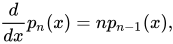
and in which 
Among the most notable Appell sequences besides the trivial example 
01Equivalent characterizations of Appell sequences
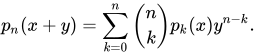
The following conditions on polynomial sequences can easily be seen to be equivalent:
- For
,
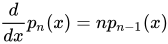
- and
- For some sequence
of scalars with
,
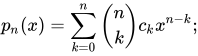
- For the same sequence of scalars,

- where

- For
,
02Recursion formula
Suppose
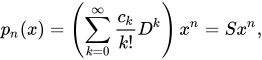
where the last equality is taken to define the linear operator 


be the inverse operator, the coefficients 
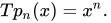
In the conventions of the umbral calculus, one often treats this formal power series 

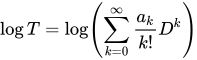
by using the usual power series expansion of the 

(This formal differentiation of a power series in the differential operator 
In the case of Hermite polynomials, this reduces to the conventional recursion formula for that sequence.
03Subgroup of the Sheffer polynomials
The set of all Appell sequences is closed under the operation of umbral composition of polynomial sequences, defined as follows. Suppose 


Then the umbral composition 


(the subscript 
Under this operation, the set of all Sheffer sequences is a non-abelian group, but the set of all Appell sequences is an abelian subgroup. That it is abelian can be seen by considering the fact that every Appell sequence is of the form
and that umbral composition of Appell sequences corresponds to multiplication of these formal power series in the operator
04Different convention
Another convention followed by some authors (see Chihara) defines this concept in a different way, conflicting with Appell's original definition, by using the identity
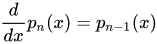
instead.
05Hypergeometric Appell polynomials
The enormous class of Appell polynomials can be obtained in terms of the generalized hypergeometric function.
Let 


Consider the polynomial

where 
Theorem.
The polynomial family 

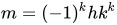
For example, if 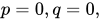





Sources and credits
This article is adapted from the Wikipedia article “Appell sequence”, written by its contributors and licensed under CC BY-SA 4.0. Fathomly has changed the layout, removed citation markers, navigation and maintenance notices, and adjusted punctuation. This adapted version is shared under the same license. For references, see the original article.
Fathomly is not affiliated with or endorsed by the Wikimedia Foundation. Spotted a problem? Tell us.