Sigma-additive set function
Mapping function
In mathematics, an additive set function is a function 


Additivity and sigma-additivity are particularly important properties of measures. They are abstractions of how intuitive properties of size (length, area, volume) of a set sum when considering multiple objects. Additivity is a weaker condition than σ-additivity; that is, σ-additivity implies additivity.
The term modular set function is equivalent to additive set function; see modularity below.
01Additive (or finitely additive) set functions
Let 

![[-\infty ,\infty ]](https://wikimedia.org/api/rest_v1/media/math/render/svg/e13233867b861889693a36843d98e51d90d38f9f)





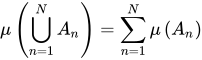
One can prove by mathematical induction that an additive function satisfies


02σ-additive set functions
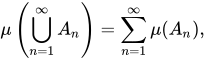 holds then
 03τ-additive set functions
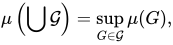
Suppose that in addition to a sigma algebra 



04Properties
Useful properties of an additive set function
Value of empty set
Either 


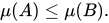
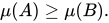
Monotonicity
If 
Modularity
A set function 



Given 




However, the related properties of submodularity and subadditivity are not equivalent to each other.
Note that modularity has a different and unrelated meaning in the context of complex functions; see modular form.
Set difference
If 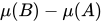

05Examples
An example of a 𝜎-additive function is the function

If 

See measure and signed measure for more examples of 𝜎-additive functions.
A charge is defined to be a finitely additive set function that maps 

An additive function which is not σ-additive
An example of an additive function which is not σ-additive is obtained by considering 



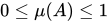


One can check that this function is additive by using the linearity of the limit. That this function is not σ-additive follows by considering the sequence of disjoint sets



06Generalizations
One may define additive functions with values in any additive monoid (for example any group or more commonly a vector space). For sigma-additivity, one needs in addition that the concept of limit of a sequence be defined on that set. For example, spectral measures are sigma-additive functions with values in a Banach algebra. Another example, also from quantum mechanics, is the positive operator-valued measure.
Sources and credits
This article is adapted from the Wikipedia article “Sigma-additive set function”, written by its contributors and licensed under CC BY-SA 4.0. Fathomly has changed the layout, removed citation markers, navigation and maintenance notices, and adjusted punctuation. This adapted version is shared under the same license. For references, see the original article.
Fathomly is not affiliated with or endorsed by the Wikimedia Foundation. Spotted a problem? Tell us.
