Hereditarily finite set
Finite sets whose elements are all hereditarily finite sets
In mathematics, specifically set theory, hereditarily finite sets are defined as finite sets whose elements are all hereditarily finite sets. In other words, the set itself is finite and all of its elements are finite sets, recursively down to the empty set.
01Formal definition
A recursive definition of well-founded hereditarily finite sets is as follows:
- Base case: the empty set is a hereditarily finite set.
- Recursion rule: if
are hereditarily finite sets, then so is
.
Only sets that can be built by a finite number of applications of these two rules are hereditarily finite.
Representation
This class of sets is naturally ranked by the number of bracket pairs necessary to represent the sets:
- One bracket pair:
(the ordinal "0").
- Two bracket pairs:
(the ordinal "1").
- Three bracket pairs:
.
- Four bracket pairs:
and also
(the ordinal "2").
- Five bracket pairs:
, also
as well as
.
- Six bracket pairs, such as
. There are six such sets.
- Seven bracket pairs, such as
. There are twelve such sets.
- Eight bracket pairs, such as
or
(the ordinal "3").
The number of sets with 


02Discussion
Not every finite set is hereditarily finite. For example, 

The class of all hereditarily finite sets is denoted by 


03Models
Ackermann coding
In 1937, Wilhelm Ackermann introduced an encoding of hereditarily finite sets as natural numbers.
It is defined by a function 
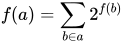
For example, the empty set 


The inverse 

where BIT denotes the BIT predicate.
The Ackermann coding can be used to construct a model of finitary set theory in the natural numbers. More precisely, 


Graph models
The class 


Graph models exist for ZF and also set theories different from Zermelo set theory, such as non-well founded theories. Such models have more intricate edge structure.
In graph theory, the graph whose vertices correspond to hereditarily finite sets and edges correspond to set membership is the Rado graph or random graph.
04Axiomatizations
Theories of finite sets
In common axiomatic set theory approaches, the empty set 
Now note that Robinson arithmetic can already be interpreted in ST, the very small sub-theory of Zermelo set theory with only the axioms of extensionality, empty set and adjunction. All of
Axiomatically characterizing the theory of hereditarily finite sets, the negation of the axiom of infinity may be added. As the theory validates the other axioms of ZF, this establishes that the axiom of infinity is not a consequence of these other ZF axioms.
ZF
The hereditarily finite sets are a subclass of the Von Neumann universe. Here, the class of all well-founded hereditarily finite sets is denoted
If we denote by 


and all its elements are finite.
This formulation shows, again, that there are only countably many hereditarily finite sets: 


Equivalently, a set is hereditarily finite if and only if its transitive closure is finite.
Sources and credits
This article is adapted from the Wikipedia article “Hereditarily finite set”, written by its contributors and licensed under CC BY-SA 4.0. Fathomly has changed the layout, removed citation markers, navigation and maintenance notices, and adjusted punctuation. This adapted version is shared under the same license. For references, see the original article.
Images, from Wikimedia Commons:
- Nested set V4.svg by Watchduck You can name the author as "T. Piesk", "Tilman Piesk" or "Watchduck"., Public domain
Fathomly is not affiliated with or endorsed by the Wikimedia Foundation. Spotted a problem? Tell us.
