Transitive set
Class of mathematical set whose elements are all subsets
In set theory, a branch of mathematics, a set 
 , and
, and  , then
  .
. is not an
 Similarly, a class 
01Examples
Using the definition of ordinal numbers suggested by John von Neumann, ordinal numbers are defined as hereditarily transitive sets: an ordinal number is a transitive set whose members are also transitive (and thus ordinals). The class of all ordinals is a transitive class.
Any of the stages 


This is a complete list of all finite transitive sets with up to 20 pairs of brackets:














































02Properties
A set 


.
Moreover, if
If 




A set 
03Transitive closure
The transitive closure of a set 

Proof. Denote 

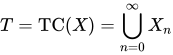
is transitive, and whenever 

Assume 


Now let 


Note that this is the set of all of the objects related to
04Transitive models of set theory
Transitive classes are often used for construction of interpretations of set theory in itself, usually called inner models. The reason is that properties defined by bounded formulas are absolute for transitive classes.
A transitive set (or class) that is a model of a formal system of set theory is called a transitive model of the system (provided that the element relation of the model is the restriction of the true element relation to the universe of the model). Transitivity is an important factor in determining the absoluteness of formulas.
In the superstructure approach to non-standard analysis, the non-standard universes satisfy strong transitivity. Here, a class 


Sources and credits
This article is adapted from the Wikipedia article “Transitive set”, written by its contributors and licensed under CC BY-SA 4.0. Fathomly has changed the layout, removed citation markers, navigation and maintenance notices, and adjusted punctuation. This adapted version is shared under the same license. For references, see the original article.
Fathomly is not affiliated with or endorsed by the Wikimedia Foundation. Spotted a problem? Tell us.