6-simplex
Uniform 6-polytope
| 6-simplex | |
|---|---|
| Type | uniform polypeton |
| Schläfli symbol | {35} |
| Coxeter diagrams | |
| Elements |
f5 = 7, f4 = 21, C = 35, F = 35, E = 21, V = 7 |
| Coxeter group | A6, [35], order 5040 |
| Bowers name and (acronym) | Heptapeton (hop) |
| Vertex figure | 5-simplex |
| Circumradius |  0.654654 |
| Properties | convex, isogonal self-dual |
In geometry, a 6-simplex is a self-dual regular 6-polytope. It has 7 vertices, 21 edges, 35 triangle faces, 35 tetrahedral cells, 21 5-cell 4-faces, and 7 5-simplex 5-faces. Its dihedral angle is cos−1(1/6), or approximately 80.41°.
01Alternate names
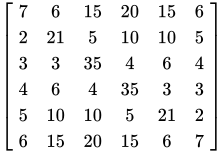
02As a configuration
This configuration matrix represents the 6-simplex. The rows and columns correspond to vertices, edges, faces, cells, 4-faces and 5-faces. The diagonal numbers say how many of each element occur in the whole 6-simplex. The nondiagonal numbers say how many of the column's element occur in or at the row's element. This self-dual simplex's matrix is identical to its 180 degree rotation.
03Coordinates
The Cartesian coordinates for an origin-centered regular heptapeton having edge length 2 are:






The vertices of the 6-simplex can be more simply positioned in 7-space as permutations of:
- (0,0,0,0,0,0,1)
This construction is based on facets of the 7-orthoplex.
04Images
| Ak Coxeter plane | A6 | A5 | A4 |
|---|---|---|---|
| Graph | |||
| Dihedral symmetry | [7] | [6] | [5] |
| Ak Coxeter plane | A3 | A2 | |
| Graph | |||
| Dihedral symmetry | [4] | [3] |
Sources and credits
This article is adapted from the Wikipedia article “6-simplex”, written by its contributors and licensed under CC BY-SA 4.0. Fathomly has changed the layout, removed citation markers, navigation and maintenance notices, and adjusted punctuation. This adapted version is shared under the same license. For references, see the original article.
Fathomly is not affiliated with or endorsed by the Wikimedia Foundation. Spotted a problem? Tell us.