N (kana)
Character of the Japanese writing system
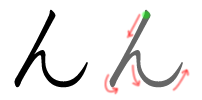
N (hiragana: ん, katakana: ン) is one of the Japanese kana, which each represent one mora. ん is the only kana that does not end in a vowel sound (although in certain cases the vowel ending of kana, such as す, is unpronounced). The kana for mu, む/ム, was originally used for the n sound as well, while ん was originally a hentaigana used for both n and mu. In the 1900 Japanese script reforms, hentaigana were officially declared obsolete and ん was officially declared a kana to represent the n sound.
In addition to being the only kana not ending with a vowel sound, it is also the only kana that does not begin any words in standard Japanese (other than foreign loan words such as "Ngorongoro", which is transcribed as ンゴロンゴロ) (see Shiritori). Some regional dialects of Japanese feature words beginning with ん, as do the Ryukyuan languages (which are usually written in the Japanese writing system), in which words starting with ン are common, such as the Okinawan word for miso, nnsu (transcribed as ンース).
The kana is followed by an apostrophe in some systems of transliteration whenever it precedes a vowel or a y- kana, so as to prevent confusion with other kana. However, like every other kana besides yōon, it represents an entire mora, so its pronunciation is, in practice, as close to "nn" as "n". The pronunciation can also change depending on what sounds surround it. These are a few of the ways it can change:
- [n] (before n, t, d, r, ts, and z)
- [m] (before m, p and b)
- [ŋ] (before k and g)
- [ɲ] (before ni, ch and j)
- [ɴ] (at the end of utterances)
- [ɯ͍̃] (before vowels, palatal approximants (y), consonants h, f, s, sh and w)
- [ĩ] (after the vowel i if another vowel, palatal approximant or consonant f, s, sh, h or w follows.)
01Other communicative representations
| Japanese radiotelephony alphabet | Wabun code |
| おしまいのン Oshimai no "N" |
▄ ▄▄▄ ▄ ▄▄▄ ▄ ⓘ |
| Japanese Navy Signal Flag | Japanese semaphore | Japanese manual syllabary (fingerspelling) | Braille dots-356 Japanese Braille |
- Full Braille representation
| ん / ン in Japanese Braille: |
|---|
| Preview | ん | ン | ン | | 𛅧 | |||||
|---|---|---|---|---|---|---|---|---|---|---|
| Unicode name | HIRAGANA LETTER N | KATAKANA LETTER N | HALFWIDTH KATAKANA LETTER N | HIRAGANA LETTER SMALL N | KATAKANA LETTER SMALL N | |||||
| Encodings | decimal | hex | dec | hex | dec | hex | dec | hex | dec | hex |
| Unicode | 12435 | U+3093 | 12531 | U+30F3 | 65437 | U+FF9D | 110947 | U+1B163 | 110951 | U+1B167 |
| UTF-8 | 227 130 147 | E3 82 93 | 227 131 179 | E3 83 B3 | 239 190 157 | EF BE 9D | 240 155 133 163 | F0 9B 85 A3 | 240 155 133 167 | F0 9B 85 A7 |
| UTF-16 | 12435 | 3093 | 12531 | 30F3 | 65437 | FF9D | 55340 56675 | D82C DD63 | 55340 56679 | D82C DD67 |
| Numeric character reference | ん | ん | ン | ン | ン | ン | 𛅣 | 𛅣 | 𛅧 | 𛅧 |
| Shift JIS | 130 241 | 82 F1 | 131 147 | 83 93 | 221 | DD | ||||
| EUC-JP | 164 243 | A4 F3 | 165 243 | A5 F3 | 142 221 | 8E DD | ||||
| GB 18030 | 164 243 | A4 F3 | 165 243 | A5 F3 | 132 49 155 55 | 84 31 9B 37 | 147 54 134 53 | 93 36 86 35 | ||
| EUC-KR / UHC | 170 243 | AA F3 | 171 243 | AB F3 | ||||||
| Big5 (non-ETEN kana) | 198 247 | C6 F7 | 199 173 | C7 AD | ||||||
| Big5 (ETEN / HKSCS) | 199 122 | C7 7A | 199 239 | C7 EF | ||||||
N is the only Katakana without a circled form in Unicode.


02Names
The kana ん and ン and the various sounds they represent are known by the names hatsuon (撥音) and haneru-on (撥ねる音). One of the various meanings of the verb haneru (撥ねる) is to "make an upward brush-stroke" when writing, which is a gesture that is involved in writing the kana ん and ン. Another meaning is rather specific, to 'pronounce "n" as a syllabic consonant', in other words, to make the sounds represented by the kana ん and ン. It is not clear whether the calligraphic gesture involved in writing the kana or some phonetic gesture involved in producing the sounds gives the names hatsuon and haneru-on. English-language literature favors the descriptive name moraic nasal for the sounds.
Historically, the name hatsuon was not used just for the Japanese moraic nasal, but also for ending nasals in Middle Chinese. The Meiji-era linguist Ōshima Masatake used the terms sokuon ("plosive") and hatsuon ("nasal") to describe ending consonants in Chinese (which he called Shinago (支那語), an outdated term used from the Edo period to after World War II). These sounds were classified as "labial" (唇內, shinnai), "lingual" (舌內, zetsunai) and "guttural" (喉內, kōnai). Hatsuon, in particular, were classified as follows: [m] is the "labial nasal" (唇內撥音), [n] is the "lingual nasal" (舌內撥音), and [ŋ] is the "guttural nasal" (喉內撥音). Another of Ōshima's descriptions even more explicitly related the terms sokuon and hatsuon to the four tones of Middle Chinese.
In earlier stages of Japanese, different realizations of the moraic nasal were actually indicated in writing. For example, during the Heian period (Early Middle Japanese), the "lingual nasal" was spelt differently when followed by a lingual consonant (/n, s/) compared to the "labial nasal" when followed by a labial consonant (/p, b, m/). In both cases, the resulting nasal indicated hatsuonbin (撥音便) (see onbin). After the 11th century, the "lingual" and "labial" realizations were no longer distinguished in writing.
03Use in the Ainu language
In the Ainu language, ン is interchangeable with the small katakana ㇴ as a final n.

Sources and credits
This article is adapted from the Wikipedia article “N (kana)”, written by its contributors and licensed under CC BY-SA 4.0. Fathomly has changed the layout, removed citation markers, navigation and maintenance notices, and adjusted punctuation. This adapted version is shared under the same license. For references, see the original article.
Images, from Wikimedia Commons:
- Hiragana ん stroke order animation.gif by Sirgazil, CC0
- Katakana ン stroke order animation.gif by Sirgazil, CC0
- ん-bw.png by No machine-readable author provided. D.328 assumed (based on copyright claims)., CC BY-SA 3.0
- ン-bw.png by No machine-readable author provided. D.328 assumed (based on copyright claims)., CC BY-SA 3.0
Fathomly is not affiliated with or endorsed by the Wikimedia Foundation. Spotted a problem? Tell us.