Inequation
Mathematical statement that two values are not equal
In mathematics, an inequation is a statement relating two values, that is either an strict inequality ("greater than", <, or "less than", >) or a relation "not equal to" (≠). It is usually written in the form of a pair of expressions denoting the values in question, with a relational sign between the two sides, indicating the specific inequality relation. Some examples of inequations are:


Sometimes, the term "inequation" is restricted to the relaton "not equal to", or is enlarged for including the relations "less than or equal to", ≤, and "greater than or equal to", ≥.
01Chains of inequations
A shorthand notation is used for the conjunction of several inequations involving common expressions, by chaining them together. For example, the chain

is shorthand for

which also implies that 

In rare cases, chains without such implications about distant terms are used.
For example 





02Solving inequations
Similar to equation solving, inequation solving means finding what values (numbers, functions, sets, etc.) fulfill a condition stated in the form of an inequation or a conjunction of several inequations. These expressions contain one or more unknowns, which are free variables for which values are sought that cause the condition to be fulfilled. To be precise, what is sought are often not necessarily actual values, but, more in general, expressions. A solution of the inequation is an assignment of expressions to the unknowns that satisfies the inequation(s); in other words, expressions such that, when they are substituted for the unknowns, make the inequations true propositions. Often, an additional objective expression (i.e., an optimization equation) is given, that is to be minimized or maximized by an optimal solution.
For example,

is a conjunction of inequations, partly written as chains (where 
Computer support in solving inequations is described in constraint programming; in particular, the simplex algorithm finds optimal solutions of linear inequations. The programming language Prolog III also supports solving algorithms for particular classes of inequalities (and other relations) as a basic language feature. For more, see constraint logic programming.
03Combinations of meanings
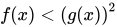
Usually because of the properties of certain functions (like square roots), some inequations are equivalent to a combination of multiple others. For example, the inequation 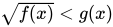


Sources and credits
This article is adapted from the Wikipedia article “Inequation”, written by its contributors and licensed under CC BY-SA 4.0. Fathomly has changed the layout, removed citation markers, navigation and maintenance notices, and adjusted punctuation. This adapted version is shared under the same license. For references, see the original article.
Images, from Wikimedia Commons:
- Linear Programming Feasible Region.svg by Inductiveload, Public domain
Fathomly is not affiliated with or endorsed by the Wikimedia Foundation. Spotted a problem? Tell us.