Reference articles on history, science, culture and more
Encyclopedia

Zonal spherical harmonics

In the mathematical study of rotational symmetry, the zonal spherical harmonics are special spherical harmonics that are invariant under the rotation through a particular fixed axis. The zonal spherical functions are a broad extension of the notion of zonal spherical harmonics to allow for a more general symmetry group.

On the two-dimensional sphere, the unique zonal spherical harmonic of degree ℓ invariant under rotations fixing the north pole is represented in spherical coordinates by Z^{(\ell )}(\theta ,\phi )={\frac {2\ell +1}{4\pi }}P_{\ell }(\cos \theta ) where P is the normalized Legendre polynomial of degree , P_{\ell }(1)=1. The generic zonal spherical harmonic of degree ℓ is denoted by Z_{\mathbf {x} }^{(\ell )}(\mathbf {y} ), where x is a point on the sphere representing the fixed axis, and y is the variable of the function. This can be obtained by rotation of the basic zonal harmonic Z^{(\ell )}(\theta ,\phi ).

In n-dimensional Euclidean space, zonal spherical harmonics are defined as follows. Let x be a point on the (n−1)-sphere. Define Z_{\mathbf {x} }^{(\ell )} to be the dual representation of the linear functional P\mapsto P(\mathbf {x} ) in the finite-dimensional Hilbert space {\mathcal {H}}_{\ell } of spherical harmonics of degree \ell with respect to the uniform measure on the sphere \mathbb {S} ^{n-1}. In other words, we have a reproducing kernel:Y(\mathbf {x} )=\int _{S^{n-1}}Z_{\mathbf {x} }^{(\ell )}(\mathbf {y} )Y(\mathbf {y} )\,d\Omega (y),\quad \forall Y\in {\mathcal {H}}_{\ell } where \Omega is the uniform measure on \mathbb {S} ^{n-1}.

01Relationship with harmonic potentials

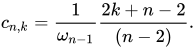
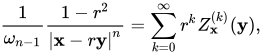
The zonal harmonics appear naturally as coefficients of the Poisson kernel for the unit ball in Rn: for x and y unit vectors, {\frac {1}{\omega _{n-1}}}{\frac {1-r^{2}}{|\mathbf {x} -r\mathbf {y} |^{n}}}=\sum _{k=0}^{\infty }r^{k}Z_{\mathbf {x} }^{(k)}(\mathbf {y} ), where \omega _{n-1} is the surface area of the (n-1)-dimensional sphere. They are also related to the Newton kernel via {\frac {1}{|\mathbf {x} -\mathbf {y} |^{n-2}}}=\sum _{k=0}^{\infty }c_{n,k}{\frac {|\mathbf {x} |^{k}}{|\mathbf {y} |^{n+k-2}}}Z_{\mathbf {x} /|\mathbf {x} |}^{(k)}(\mathbf {y} /|\mathbf {y} |) where x,y Rn and the constants cn,k are given by c_{n,k}={\frac {1}{\omega _{n-1}}}{\frac {2k+n-2}{(n-2)}}.
The coefficients of the Taylor series of the Newton kernel (with suitable normalization) are precisely the ultraspherical polynomials. Thus, the zonal spherical harmonics can be expressed as follows. If α = (n−2)/2, then Z_{\mathbf {x} }^{(\ell )}(\mathbf {y} )={\frac {n+2\ell -2}{n-2}}C_{\ell }^{(\alpha )}(\mathbf {x} \cdot \mathbf {y} ) where c_{n,\ell } are the constants above and C_{\ell }^{(\alpha )} is the ultraspherical polynomial of degree \ell. The 2-dimensional caseZ^{(\ell )}(\theta ,\phi )={\frac {2\ell +1}{4\pi }}P_{\ell }(\cos \theta )is a special case of that, since the Legendre polynomials are the special case of the ultraspherical polynomial when \alpha =1/2.

02Properties

  • The zonal spherical harmonics are rotationally invariant, meaning that Z_{R\mathbf {x} }^{(\ell )}(R\mathbf {y} )=Z_{\mathbf {x} }^{(\ell )}(\mathbf {y} ) for every orthogonal transformation R. Conversely, any function f(x,y) on Sn−1×Sn−1 that is a spherical harmonic in y for each fixed x, and that satisfies this invariance property, is a constant multiple of the degree zonal harmonic.
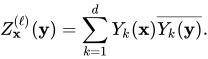
  • If Y1, ..., Yd is an orthonormal basis of H, then Z_{\mathbf {x} }^{(\ell )}(\mathbf {y} )=\sum _{k=1}^{d}Y_{k}(\mathbf {x} ){\overline {Y_{k}(\mathbf {y} )}}.
  • Evaluating at x = y gives Z_{\mathbf {x} }^{(\ell )}(\mathbf {x} )=\omega _{n-1}^{-1}\dim \mathbf {H} _{\ell }.
Watch videos about Zonal spherical harmonicsExplainers and documentaries on YouTube (opens in a new tab)

Sources and credits

This article is adapted from the Wikipedia article Zonal spherical harmonics, written by its contributors and licensed under CC BY-SA 4.0. Fathomly has changed the layout, removed citation markers, navigation and maintenance notices, and adjusted punctuation. This adapted version is shared under the same license. For references, see the original article.

Fathomly is not affiliated with or endorsed by the Wikimedia Foundation. Spotted a problem? Tell us.