Zero-forcing precoding
Zero-forcing (or null-steering) precoding is a method of spatial signal processing by which a multiple antenna transmitter can null the multiuser interference in a multi-user MIMO wireless communication system. When the channel state information is perfectly known at the transmitter, the zero-forcing precoder is given by the pseudo-inverse of the channel matrix. Zero-forcing has been used in LTE mobile networks.
01Mathematical description
In a multiple antenna downlink system which comprises 



where 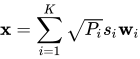


The above signal model can be more compactly re-written as

where
is the
received signal vector,
is
channel matrix,
is the
is a
diagonal power matrix, and
is the
A zero-forcing precoder is defined as a precoder where 



Thus the interference caused by the signal meant for one user is effectively nullified for rest of the users via zero-forcing precoder.
From the fact that each beam generated by zero-forcing precoder is orthogonal to all the other user channel vectors, one can rewrite the received signal as

The orthogonality condition can be expressed in matrix form as

where 



Given this zero-forcing precoder design, the received signal at each user is decoupled from each other as

02Quantify the feedback amount
Quantify the amount of the feedback resource required to maintain at least a given throughput performance gap between zero-forcing with perfect feedback and with limited feedback, i.e.,
.
Jindal showed that the required feedback bits of a spatially uncorrelated channel should be scaled according to SNR of the downlink channel, which is given by:

where M is the number of transmit antennas and 
To feed back B bits though the uplink channel, the throughput performance of the uplink channel should be larger than or equal to 'B'

where 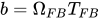


.
Note that differently from the feedback bits case, the required feedback resource is a function of both downlink and uplink channel conditions. It is reasonable to include the uplink channel status in the calculation of the feedback resource since the uplink channel status determines the capacity, i.e., bits/second per unit frequency band (Hz), of the feedback link. Consider a case when SNR of the downlink and uplink are proportion such that 
.
It follows from the above equation that the feedback resource (
03Performance
If the transmitter knows the downlink channel state information (CSI) perfectly, ZF-precoding can achieve almost the system capacity when the number of users is large. On the other hand, with limited channel state information at the transmitter (CSIT) the performance of ZF-precoding decreases depending on the accuracy of CSIT. ZF-precoding requires the significant feedback overhead with respect to signal-to-noise-ratio (SNR) so as to achieve the full multiplexing gain. Inaccurate CSIT results in the significant throughput loss because of residual multiuser interferences. Multiuser interferences remain since they can not be nulled with beams generated by imperfect CSIT.
Sources and credits
This article is adapted from the Wikipedia article “Zero-forcing precoding”, written by its contributors and licensed under CC BY-SA 4.0. Fathomly has changed the layout, removed citation markers, navigation and maintenance notices, and adjusted punctuation. This adapted version is shared under the same license. For references, see the original article.
Fathomly is not affiliated with or endorsed by the Wikimedia Foundation. Spotted a problem? Tell us.
