Admittance parameters
Properties of an electrical network
Admittance parameters or Y-parameters (the elements of an admittance matrix or Y-matrix) are properties used in many areas of electrical engineering, such as power, electronics, and telecommunications. These parameters are used to describe the electrical behavior of linear electrical networks. They are also used to describe the small-signal (linearized) response of non-linear networks. Y parameters are also known as short circuited admittance parameters. They are members of a family of similar parameters used in electronic engineering, other examples being: S-parameters, Z-parameters, H-parameters, T-parameters or ABCD-parameters.
01The Y-parameter matrix
A Y-parameter matrix describes the behaviour of any linear electrical network that can be regarded as a black box with a number of ports. A port in this context is a pair of electrical terminals carrying equal and opposite currents into and out of the network, and having a particular voltage between them. The Y-matrix gives no information about the behaviour of the network when the currents at any port are not balanced in this way (should this be possible), nor does it give any information about the voltage between terminals not belonging to the same port. Typically, it is intended that each external connection to the network is between the terminals of just one port, so that these limitations are appropriate.
For a generic multi-port network definition, it is assumed that each of the ports is allocated an integer n ranging from 1 to N, where N is the total number of ports. For port n, the associated Y-parameter definition is in terms of the port voltage and port current, Vn and In respectively.
For all ports the currents may be defined in terms of the Y-parameter matrix and the voltages by the following matrix equation:

where Y is an N × N matrix the elements of which can be indexed using conventional matrix notation. In general the elements of the Y-parameter matrix are complex numbers and functions of frequency. For a one-port network, the Y-matrix reduces to a single element, being the ordinary admittance measured between the two terminals.

02Two-port networks
The Y-parameter matrix for the two-port network is probably the most common. In this case the relationship between the port voltages, port currents and the Y-parameter matrix is given by:
.
where
![{\begin{aligned}Y_{11}&={I_{1} \over V_{1}}{\bigg |}_{V_{2}=0}\qquad Y_{12}={I_{1} \over V_{2}}{\bigg |}_{V_{1}=0}\\[8pt]Y_{21}&={I_{2} \over V_{1}}{\bigg |}_{V_{2}=0}\qquad Y_{22}={I_{2} \over V_{2}}{\bigg |}_{V_{1}=0}\end{aligned}}](https://wikimedia.org/api/rest_v1/media/math/render/svg/0b522875ab5fda054459cb12be3247a416aee01c)
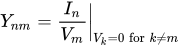
For the general case of an n-port network,
Admittance relations
The input admittance of a two-port network is given by:
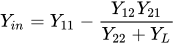
where YL is the admittance of the load connected to port two.
Similarly, the output admittance is given by:
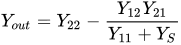
where YS is the admittance of the source connected to port one.
03Relation to S-parameters
The Y-parameters of a network are related to its S-parameters by
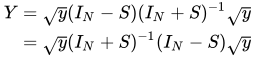
and

where IN is the identity matrix, 
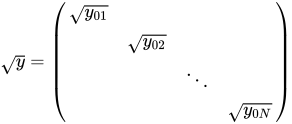
and 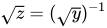
Two port
In the special case of a two-port network, with the same and real characteristic admittance 
![{\begin{aligned}Y_{11}&={(1-S_{11})(1+S_{22})+S_{12}S_{21} \over \Delta _{S}}Y_{0}\\Y_{12}&={-2S_{12} \over \Delta _{S}}Y_{0}\\[4pt]Y_{21}&={-2S_{21} \over \Delta _{S}}Y_{0}\\[4pt]Y_{22}&={(1+S_{11})(1-S_{22})+S_{12}S_{21} \over \Delta _{S}}Y_{0}\end{aligned}}](https://wikimedia.org/api/rest_v1/media/math/render/svg/b3a616cadca1cf9f8371d9bfe07b8c7d5390ccc9)
where

The above expressions will generally use complex numbers for 


The two-port S-parameters may also be obtained from the equivalent two-port Y-parameters by means of the following expressions.
![{\begin{aligned}S_{11}&={(1-Z_{0}Y_{11})(1+Z_{0}Y_{22})+Z_{0}^{2}Y_{12}Y_{21} \over \Delta }\\S_{12}&={-2Z_{0}Y_{12} \over \Delta }\\[4pt]S_{21}&={-2Z_{0}Y_{21} \over \Delta }\\[4pt]S_{22}&={(1+Z_{0}Y_{11})(1-Z_{0}Y_{22})+Z_{0}^{2}Y_{12}Y_{21} \over \Delta }\end{aligned}}](https://wikimedia.org/api/rest_v1/media/math/render/svg/0c7c42c659271a252e92fd9c46d2c57a5435b835)
where

and 

04Relation to Z-parameters
Conversion from Z-parameters to Y-parameters is much simpler, as the Y-parameter matrix is just the inverse of the Z-parameter matrix. The following expressions show the applicable relations:
![{\begin{aligned}Y_{11}&={Z_{22} \over |Z|}\\[4pt]Y_{12}&={-Z_{12} \over |Z|}\\[4pt]Y_{21}&={-Z_{21} \over |Z|}\\[4pt]Y_{22}&={Z_{11} \over |Z|}\end{aligned}}](https://wikimedia.org/api/rest_v1/media/math/render/svg/fdc62a4d7e9e726981a4ac2dbe7b5d45319ea885)
where

In this case 
Vice versa the Y-parameters can be used to determine the Z-parameters, essentially using the same expressions since

and

Sources and credits
This article is adapted from the Wikipedia article “Admittance parameters”, written by its contributors and licensed under CC BY-SA 4.0. Fathomly has changed the layout, removed citation markers, navigation and maintenance notices, and adjusted punctuation. This adapted version is shared under the same license. For references, see the original article.
Images, from Wikimedia Commons:
- Two-Port Y-parameters Norton equivalent.svg by دالبا, CC BY-SA 3.0
- Equivalent circuit for Y-parameters of a reciprocal two-port network.svg by دالبا, CC BY-SA 3.0
Fathomly is not affiliated with or endorsed by the Wikimedia Foundation. Spotted a problem? Tell us.