Wright omega function
Mathematical function

In mathematics, the Wright omega function or Wright function, denoted ω, is defined in terms of the Lambert W function as:
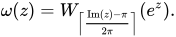
It is simpler to be defined by its inverse function

01Uses
One of the main applications of this function is in the resolution of the equation z = ln(z), as the only solution is given by z = e−ω(π i).
y = ω(z) is the unique solution, when 
02Properties
The Wright omega function satisfies the relation 
It also satisfies the differential equation
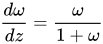
wherever ω is analytic (as can be seen by performing separation of variables and recovering the equation 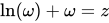

Its Taylor series around the point 
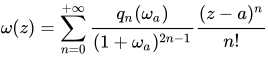
where
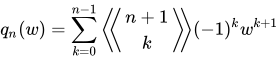
in which

Sources and credits
This article is adapted from the Wikipedia article “Wright omega function”, written by its contributors and licensed under CC BY-SA 4.0. Fathomly has changed the layout, removed citation markers, navigation and maintenance notices, and adjusted punctuation. This adapted version is shared under the same license. For references, see the original article.
Images, from Wikimedia Commons:
- WrightOmega.png by Sam Derbyshire, CC BY-SA 3.0
Fathomly is not affiliated with or endorsed by the Wikimedia Foundation. Spotted a problem? Tell us.