Well-defined expression
Expression whose definition assigns it a unique interpretation
In mathematics, a well-defined expression or unambiguous expression is an expression whose definition assigns it a unique interpretation or value. Otherwise, the expression is said to be not well defined, ill-defined or ambiguous. A function is well defined if it gives the same result when the representation of the input is changed without changing the value of the input. For instance, if 


A function that is not well defined is not the same as a function that is undefined. For example, if 

01Example
Let 

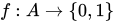


Then 


However, if 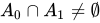


02"Definition" as anticipation of definition
In order to avoid the quotation marks around "define" in the previous simple example, the "definition" of
- The definition of the binary relation. In the example:
.)
- The assertion. The binary relation


While the definition in step 1 is formulated with the freedom of any definition and is certainly effective (without the need to classify it as "well defined"), the assertion in step 2 has to be proven. That is, 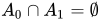
On the other hand, if 


Despite these subtle logical problems, it is quite common to use the term definition (without apostrophes) for "definitions" of this kind, for three reasons:
- It provides a handy shorthand of the two-step approach.
- The relevant mathematical reasoning (i.e., step 2) is the same in both cases.
- In mathematical texts, the assertion is "up to 100%" true.
03Independence of representative
Questions regarding the well-definedness of a function often arise when the defining equation of a function refers not only to the arguments themselves, but also to elements of the arguments, serving as representatives. This is sometimes unavoidable when the arguments are cosets and when the equation refers to coset representatives. The result of a function application must then not depend on the choice of representative.
Functions with one argument
For example, consider the following function:
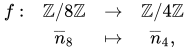
where 


N.B.: 


The function

As a counter example, the converse definition:
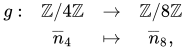
does not lead to a well-defined function, since e.g. 


Operations
In particular, the term well-defined is used with respect to (binary) operations on cosets. In this case, one can view the operation as a function of two variables, and the property of being well-defined is the same as that for a function. For example, addition on the integers modulo some n can be defined naturally in terms of integer addition.
![[a]\oplus [b]=[a+b]](https://wikimedia.org/api/rest_v1/media/math/render/svg/3795c6b625447d3607a3979a49f10328aeaaf25f)
The fact that this is well-defined follows from the fact that we can write any representative of ![[a]](https://wikimedia.org/api/rest_v1/media/math/render/svg/ea82bc70a8e322f13a3c4e5b9d5d69e8ef097ad8)


![[a]\oplus [b]=[a+kn]\oplus [b]=[(a+kn)+b]=[(a+b)+kn]=[a+b];](https://wikimedia.org/api/rest_v1/media/math/render/svg/ad0e16a047b326bd1daa86fc21b84ef986f3d7a5)
similar holds for any representative of ![[b]](https://wikimedia.org/api/rest_v1/media/math/render/svg/e016d81a1b29bb79b275e446042b925b7dd6b6d7)
![[a+b]](https://wikimedia.org/api/rest_v1/media/math/render/svg/f4b7d37d08b05354ad6b15e9f9f1cbc82190c607)
04Well-defined notation
For real numbers, the product 


Unlike with functions, notational ambiguities can be overcome by means of additional definitions (e.g., rules of precedence, associativity of the operator). For example, in the programming language C, the operator - for subtraction is left-to-right-associative, which means that a-b-c is defined as (a-b)-c, and the operator = for assignment is right-to-left-associative, which means that a=b=c is defined as a=(b=c). In the programming language APL there is only one rule: from right to left, but parentheses first.
05Other uses of the term
A solution to a partial differential equation is said to be well-defined if it is continuously determined by boundary conditions as those boundary conditions are changed.
Sources and credits
This article is adapted from the Wikipedia article “Well-defined expression”, written by its contributors and licensed under CC BY-SA 4.0. Fathomly has changed the layout, removed citation markers, navigation and maintenance notices, and adjusted punctuation. This adapted version is shared under the same license. For references, see the original article.
Fathomly is not affiliated with or endorsed by the Wikimedia Foundation. Spotted a problem? Tell us.

