Logical NOR
Binary operation that is true if and only if both operands are false

In Boolean logic, logical NOR, non-disjunction, or joint denial is a truth-functional operator which produces a result that is the negation of logical or. That is, a sentence of the form (p NOR q) is true precisely when neither p nor q is true, i.e. when both p and q are false. It is logically equivalent to 


Non-disjunction is usually denoted as 


As with its dual, the NAND operator (also known as the Sheffer stroke, symbolized as either 


The computer used in the spacecraft that first carried humans to the moon, the Apollo Guidance Computer, was constructed entirely using NOR gates with three inputs.
01Definition
The NOR operation is a logical operation on two logical values, typically the values of two propositions, that produces a value of true if and only if both operands are false. In other words, it produces a value of false if and only if at least one operand is true.
Truth table
The truth table of 
 |  | |
|---|---|---|
| F | F | T |
| F | T | F |
| T | F | F |
| T | T | F |
Logical equivalences
The logical NOR
 |
 |
 |
| |
|
02Alternative notations and names
Peirce is the first to show the functional completeness of non-disjunction while he doesn't publish his result. Peirce used 

In 1911, Stamm was the first to publish a description of both non-conjunction (using 

In 1913, Sheffer described non-disjunction and showed its functional completeness. Sheffer used 
In 1935, Donald L. Webb described non-disjunction for 
In 1940, Quine also described non-disjunction and use
In 1944, Church also described non-disjunction and use
In 1954, Bocheński used 
APL uses a glyph ⍱ that combines a ∨ with a ~.
03Properties
NOR is commutative but not associative, which means that 

Functional completeness
The logical NOR, taken by itself, is a functionally complete set of connectives. This can be proved by first showing, with a truth table, that 


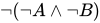

This may also be seen from the fact that Logical NOR does not possess any of the five qualities (truth-preserving, false-preserving, linear, monotonic, self-dual) required to be absent from at least one member of a set of functionally complete operators.
04Other Boolean operations in terms of the logical NOR
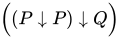
NOR has the interesting feature that all other logical operators can be expressed by interlaced NOR operations. The logical NAND operator also has this ability.
Expressed in terms of NOR
|
| |||||||||||||||||||||
|
|




Sources and credits
This article is adapted from the Wikipedia article “Logical NOR”, written by its contributors and licensed under CC BY-SA 4.0. Fathomly has changed the layout, removed citation markers, navigation and maintenance notices, and adjusted punctuation. This adapted version is shared under the same license. For references, see the original article.
Images, from Wikimedia Commons:
- Venn1000.svg by Unknown author, Public domain
Fathomly is not affiliated with or endorsed by the Wikimedia Foundation. Spotted a problem? Tell us.