Wavelet transform
Mathematical technique used in data compression and analysis

In mathematics, a wavelet series is a representation of a square-integrable (real- or complex-valued) function by a certain orthonormal series generated by a wavelet. This article provides a formal, mathematical definition of an orthonormal wavelet and of the integral wavelet transform.
01Definition
A function 
The Hilbert basis is constructed as the family of functions 


If, under the standard inner product on 


Completeness is satisfied if every function 
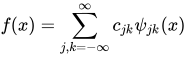
with convergence of the series understood to be convergence in norm. Such a representation of 
The integral wavelet transform is the integral transform defined as
={\frac {1}{\sqrt {|a|}}}\int _{-\infty }^{\infty }{\overline {\psi \left({\frac {x-b}{a}}\right)}}f(x)dx\,](https://wikimedia.org/api/rest_v1/media/math/render/svg/09da9cf5e885b5d51ae91ae47a8017d2e36eb88a)

![c_{jk}=\left[W_{\psi }f\right]\left(2^{-j},k2^{-j}\right)](https://wikimedia.org/api/rest_v1/media/math/render/svg/74f652c25d621f9a0cc289aa269e7d42179b109c)
Here, 


02Principle
The fundamental idea of wavelet transforms is that the transformation should allow only changes in time extension, but not shape, imposing a restriction on choosing suitable basis functions. Changes in the time extension are expected to conform to the corresponding analysis frequency of the basis function. Based on the uncertainty principle of signal processing,

where 


The higher the required resolution in time, the lower the resolution in frequency has to be. The larger the extension of the analysis windows is chosen, the larger is the value of 
When
- Bad time resolution
- Good frequency resolution
- Low frequency, large scaling factor
When
- Good time resolution
- Bad frequency resolution
- High frequency, small scaling factor
In other words, the basis function 

This shows that wavelet transformation is good in time resolution of high frequencies, while for slowly varying functions, the frequency resolution is remarkable.
Another example: The analysis of three superposed sinusoidal signals 
03Wavelet compression
Wavelet compression is a form of data compression well suited for image compression (sometimes also video compression and audio compression). Notable implementations are JPEG 2000, DjVu and ECW for still images, JPEG XS, CineForm, and the BBC's Dirac. The goal is to store image data in as little space as possible in a file. Wavelet compression can be either lossless or lossy.
Method
First a wavelet transform is applied. This produces as many coefficients as there are pixels in the image (i.e., there is no compression yet since it is only a transform). These coefficients can then be compressed more easily because the information is statistically concentrated in just a few coefficients. This principle is called transform coding. After that, the coefficients are quantized and the quantized values are entropy encoded and/or run length encoded.
A few 1D and 2D applications of wavelet compression use a technique called "wavelet footprints".
Evaluation
Requirement for image compression
For most natural images, the spectrum density of lower frequency is higher. As a result, information of the low frequency signal (reference signal) is generally preserved, while the information in the detail signal is discarded. From the perspective of image compression and reconstruction, a wavelet should meet the following criteria while performing image compression:
- Being able to transform more original image into the reference signal.
- Highest fidelity reconstruction based on the reference signal.
- Should not lead to artifacts in the image reconstructed from the reference signal alone.
Requirement for shift variance and ringing behavior
Wavelet image compression system involves filters and decimation, so it can be described as a linear shift-variant system. A typical wavelet transformation diagram is displayed below:
The transformation system contains two analysis filters (a low pass filter 


| Length | Filter coefficients | Regularity | ||
|---|---|---|---|---|
| Wavelet filter 1 | H0 | 9 | .852699, .377402, -.110624, -.023849, .037828 | 1.068 |
| G0 | 7 | .788486, .418092, -.040689, -.064539 | 1.701 | |
| Wavelet filter 2 | H0 | 6 | .788486, .047699, -.129078 | 0.701 |
| G0 | 10 | .615051, .133389, -.067237, .006989, .018914 | 2.068 |
By observing the impulse responses of the two filters, we can conclude that the second filter is less sensitive to the input location (i.e. it is less shift variant).
Another important issue for image compression and reconstruction is the system's oscillatory behavior, which might lead to severe undesired artifacts in the reconstructed image. To achieve this, the wavelet filters should have a large peak to sidelobe ratio.
So far we have discussed about one-dimension transformation of the image compression system. This issue can be extended to two dimension, while a more general term - shiftable multiscale transforms - is proposed.
Derivation of impulse response
As mentioned earlier, impulse response can be used to evaluate the image compression/reconstruction system.
For the input sequence 


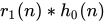


On the other hand, to reconstruct the signal x(n), we can consider a reference signal 




To obtain the overall L level analysis/synthesis system, the analysis and synthesis responses are combined as below:

Finally, the peak to first sidelobe ratio and the average second sidelobe of the overall impulse response 
Using a wavelet transform, the wavelet compression methods are adequate for representing transients, such as percussion sounds in audio, or high-frequency components in two-dimensional images, for example an image of stars on a night sky. This means that the transient elements of a data signal can be represented by a smaller amount of information than would be the case if some other transform, such as the more widespread discrete cosine transform, had been used.
Limitations
While wavelet transforms offer theoretical advantages, their practical limitations have effectively limited wavelet compression to analyzing localized changes and transient signals. Despite decades of research, wavelet-based compression systems for common multimedia like audio and video do not consistently match the efficiency and perceptual quality of current Discrete Cosine Transform-based systems.
For one-dimensional data like audio or ECGs, wavelets excel at representing and compressing transient signals, sudden, isolated events such as a drum hit in music or the sharp peaks in a heart rhythm. For example, the discrete wavelet transform has been successfully applied for the compression of electrocardiograph (ECG) signals. However, for smooth, periodic signals, which make up much of typical audio, harmonic analysis in the frequency domain with Fourier-related transforms achieve better compression and sound quality. Compressing data that has both transient and periodic characteristics may be done with hybrid techniques that use wavelets along with traditional harmonic analysis. For example, the Vorbis audio codec primarily uses the modified discrete cosine transform to compress audio (which is generally smooth and periodic), however allows the addition of a hybrid wavelet filter bank for improved reproduction of transients.
For higher-dimensional data, wavelet compression faces significant challenges. In video, for instance, modern compression techniques such as intra coding and motion compensation (predicting parts of an image based on what's next to it spatially and temporally) and mixed and dynamic block sizes become incredibly complex with wavelets because of their overlapping nature. This complexity translates to more processing power and slower speed, making them less practical for widespread use. Furthermore, while wavelets might score well on traditional measures such as PSNR, DCT blocks create a perception of sharpness that wavelets often lack, requiring higher bitrates to achieve similar subjective quality.

04Comparison with Fourier transform and time-frequency analysis
| Transform | Representation | Input |
|---|---|---|
| Fourier transform |  | : frequency |
| Time-frequency analysis |  | time; frequency |
| Wavelet transform |  |  scaling ; scaling ;  time shift factor time shift factor |
Wavelets have some slight benefits over Fourier transforms in reducing computations when examining specific frequencies. However, they are rarely more sensitive, and indeed, the common Morlet wavelet is mathematically identical to a short-time Fourier transform using a Gaussian window function. The exception is when searching for signals of a known, non-sinusoidal shape (e.g., heartbeats); in that case, using matched wavelets can outperform standard STFT/Morlet analyses.
05Other practical applications
The wavelet transform can provide us with the frequency of the signals and the time associated to those frequencies, making it very convenient for its application in numerous fields. For instance, signal processing of accelerations for gait analysis, for fault detection, for the analysis of seasonal displacements of landslides, for design of low power pacemakers and also in ultra-wideband (UWB) wireless communications.
- Discretizing of the
axis Applied the following discretization of frequency and time:
Leading to wavelets of the form, the discrete formula for the basis wavelet:
Such discrete wavelets can be used for the transformation:
- Implementation via the FFT (fast Fourier transform)
As apparent from wavelet-transformation representation (shown below)
where
is scaling factor,
represents time shift factor
and as already mentioned in this context, the wavelet-transformation corresponds to a convolution of a function
and a wavelet-function. A convolution can be implemented as a multiplication in the frequency domain. With this the following approach of implementation results into:
- Fourier-transformation of signal
with the FFT
- Selection of a discrete scaling factor
- Scaling of the wavelet-basis-function by this factor
and subsequent FFT of this function
- Multiplication with the transformed signal YFFT of the first step
- Inverse transformation of the product into the time domain results in
for different discrete values of
- Back to the second step, until all discrete scaling values for
- Fault detection in electrical power systems.
- Locally adaptive statistical estimation of functions whose smoothness varies substantially over the domain, or more specifically, estimation of functions that are sparse in the wavelet domain.
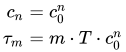
![\Psi (k,n,m)={\frac {1}{\sqrt {c_{0}^{n}}}}\cdot \Psi \left[{\frac {k-mc_{0}^{n}}{c_{0}^{n}}}T\right]={\frac {1}{\sqrt {c_{0}^{n}}}}\cdot \Psi \left[\left({\frac {k}{c_{0}^{n}}}-m\right)T\right]](https://wikimedia.org/api/rest_v1/media/math/render/svg/4263560e2b2433fe934d623b934e1efe521096fd)
![Y_{DW}(n,m)={\frac {1}{\sqrt {c_{0}^{n}}}}\cdot \sum _{k=0}^{K-1}y(k)\cdot \Psi \left[\left({\frac {k}{c_{0}^{n}}}-m\right)T\right]](https://wikimedia.org/api/rest_v1/media/math/render/svg/4d92ee37dd94e095b213ac5b7781dfacbe5f1c39)


06Time-causal wavelets
For processing temporal signals in real time, it is essential that the wavelet filters do not access signal values from the future as well as that minimal temporal latencies can be obtained. Time-causal wavelets representations have been developed by Szu et al and Lindeberg, with the latter method also involving a memory-efficient time-recursive implementation.
07Synchro-squeezed transform
Synchro-squeezed transform can significantly enhance temporal and frequency resolution of time-frequency representation obtained using conventional wavelet transform.
Sources and credits
This article is adapted from the Wikipedia article “Wavelet transform”, written by its contributors and licensed under CC BY-SA 4.0. Fathomly has changed the layout, removed citation markers, navigation and maintenance notices, and adjusted punctuation. This adapted version is shared under the same license. For references, see the original article.
Images, from Wikimedia Commons:
- Jpeg2000 2-level wavelet transform-lichtenstein.png by Alessio Damato, CC BY-SA 3.0
- Basis function with compression factor.jpg by Imhotaru, CC BY-SA 3.0
- STFT and WT.jpg by Imhotaru, CC BY-SA 3.0
- Analysis of three superposed sinusoidal signals.jpg by Imhotaru, CC BY-SA 3.0
Fathomly is not affiliated with or endorsed by the Wikimedia Foundation. Spotted a problem? Tell us.
