Wave function renormalization
Process to make sure wave functions can induce probability distributions
In quantum field theory, wave function renormalization is a rescaling (or renormalization) of quantum fields to take into account the effects of interactions.
For a noninteracting or free field, the field operator creates or annihilates a single particle with probability 1. Once interactions are included, however, this probability is modified in general to Z 
This appears when one calculates the propagator beyond leading order; e.g. for a scalar field,
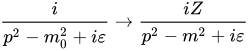
(The shift of the mass from m0 to m constitutes the mass renormalization.)
One possible wave function renormalization, which happens to be scale independent, is to rescale the fields so that the Lehmann weight (Z in the formula above) of their quanta is 1. For the purposes of studying renormalization group flows, if the coefficient of the kinetic term in the action at the scale Λ is Z, then the field is rescaled by 
Sources and credits
This article is adapted from the Wikipedia article “Wave function renormalization”, written by its contributors and licensed under CC BY-SA 4.0. Fathomly has changed the layout, removed citation markers, navigation and maintenance notices, and adjusted punctuation. This adapted version is shared under the same license. For references, see the original article.
Fathomly is not affiliated with or endorsed by the Wikimedia Foundation. Spotted a problem? Tell us.
