WORHP
Mathematical software library

WORHP (/wɔːrp/ "warp", an acronym for "We Optimize Really Huge Problems"), also referred to as eNLP (European NLP solver) by ESA, is a mathematical software library for numerically solving large scale continuous nonlinear optimization problems.
WORHP is a hybrid Fortran and C implementation and can be used from C/C++ and Fortran programs using different interfaces of varying complexity and flexibility. There are also interfaces for the MATLAB, CasADi and AMPL modelling environments.
01Problem formulation
WORHP is designed to solve problems of the form
- subject to

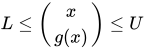
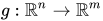
with sufficiently smooth functions 


Derivatives
WORHP requires the first derivative (Gradient) of 

02Structure
The NLP level of WORHP is based on SQP, while the quadratic subproblems are solved using an interior point method. This approach was chosen to benefit from the robustness of SQP methods and the reliable runtime complexity of IP methods, since traditional active set methods may be unsuitable for large-scale problems.
03Development
Development of WORHP started in 2006 with funding from DLR and was continued under the eNLP label after 2008 with support by ESA / ESTEC together with the Interior-Point solver ipfilter (whose inclusion in eNLP was discontinued after 2010) to develop a European NLP solver for use in trajectory optimisation, mission analysis and aerospace applications in general.
The development of WORHP is led by the Steinbeis-Forschungszentrum Optimierung, Steuerung und Regelung and scientists of the Optimization and Optimal Control Group at the University of Bremen, and at the University of the Bundeswehr Munich. The developers stress that WORHP, despite its academic roots, is intended as industrial-grade tool rather than an academic research platform.
04Applications
WORHP has been integrated into trajectory analysis tools such as LOTNAV and ASTOS, and is being used at ESOC and ESTEC. It can be used as optimiser in CasADi (since version 1.5.0beta) and as local optimiser in SVAGO MDO tool developed at University of Bremen and Politecnico di Milano on Multidisciplinary design optimization through the ESA PRESTIGE program.
Sources and credits
This article is adapted from the Wikipedia article “WORHP”, written by its contributors and licensed under CC BY-SA 4.0. Fathomly has changed the layout, removed citation markers, navigation and maintenance notices, and adjusted punctuation. This adapted version is shared under the same license. For references, see the original article.
Images, from Wikimedia Commons:
- Worhp 933x581.png by Unknown author, Fair use
Fathomly is not affiliated with or endorsed by the Wikimedia Foundation. Spotted a problem? Tell us.