Vertex function
Effective particle coupling beyond tree level
In quantum electrodynamics, the vertex function describes the coupling between a photon and an electron beyond the leading order of perturbation theory. In particular, it is the one particle irreducible correlation function involving the fermion 

01Definition
The vertex function 
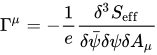
The dominant (and classical) contribution to 

where ![\sigma ^{\mu \nu }=(i/2)[\gamma ^{\mu },\gamma ^{\nu }]](https://wikimedia.org/api/rest_v1/media/math/render/svg/5f420e36cf319388eb48505f5c2caa2c8864db36)

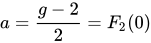
In 1948, Julian Schwinger calculated the first correction to anomalous magnetic moment, given by

where α is the fine-structure constant.

Sources and credits
This article is adapted from the Wikipedia article “Vertex function”, written by its contributors and licensed under CC BY-SA 4.0. Fathomly has changed the layout, removed citation markers, navigation and maintenance notices, and adjusted punctuation. This adapted version is shared under the same license. For references, see the original article.
Images, from Wikimedia Commons:
- Vertex correction.svg by User:Harmaa, Public domain
Fathomly is not affiliated with or endorsed by the Wikimedia Foundation. Spotted a problem? Tell us.