Variables sampling plan
Acceptance Sampling Technique
In statistics, a variables sampling plan is an acceptance sampling technique. Plans for variables are intended for quality characteristics that are measured on a continuous scale. This plan requires the knowledge of the statistical model (e.g. normal distribution). The historical evolution of this technique dates back to the seminal work of W. Allen Wallis (1943). The purpose of a plan for variables is to assess whether the process is operating far enough from the specification limit. Plans for variables may produce a similar OC curve to attribute plans with significantly less sample size.
The decision criterion of these plans are
or

where 


A variables sampling plan can be designed so that the OC curve passes through two points (AQL,


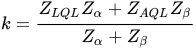
where 
When the dispersion is known the required sample size (
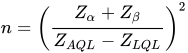
while for unknown

The MIL-STD-414 provides tables to obtain the required sample size and the critical distance according to the type of inspection.
Sources and credits
This article is adapted from the Wikipedia article “Variables sampling plan”, written by its contributors and licensed under CC BY-SA 4.0. Fathomly has changed the layout, removed citation markers, navigation and maintenance notices, and adjusted punctuation. This adapted version is shared under the same license. For references, see the original article.
Fathomly is not affiliated with or endorsed by the Wikimedia Foundation. Spotted a problem? Tell us.