Universal generalization
Rule of inference in predicate logic
In predicate logic, generalization (also universal generalization, universal introduction, GEN, UG) is a valid inference rule. It states that if 

01Generalization with hypotheses
The full generalization rule allows for hypotheses to the left of the turnstile, but with restrictions. Assume 


These restrictions are necessary for soundness. Without the first restriction, one could conclude 

(Hypothesis)
(Existential instantiation)
(Existential instantiation)
(Faulty universal generalization)
This purports to show that 


02Example of a proof
Prove: 


Proof:
| Step | Formula | Justification |
|---|---|---|
| 1 | |
Hypothesis |
| 2 | |
Hypothesis |
| 3 |  |
From (1) by Universal instantiation |
| 4 | 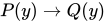 |
From (1) and (3) by Modus ponens |
| 5 |  |
From (2) by Universal instantiation |
| 6 |  |
From (2) and (5) by Modus ponens |
| 7 |  |
From (6) and (4) by Modus ponens |
| 8 |  |
From (7) by Generalization |
| 9 |  |
Summary of (1) through (8) |
| 10 |  |
From (9) by Deduction theorem |
| 11 |  |
From (10) by Deduction theorem |
In this proof, universal generalization was used in step 8. The deduction theorem was applicable in steps 10 and 11 because the formulas being moved have no free variables.
Sources and credits
This article is adapted from the Wikipedia article “Universal generalization”, written by its contributors and licensed under CC BY-SA 4.0. Fathomly has changed the layout, removed citation markers, navigation and maintenance notices, and adjusted punctuation. This adapted version is shared under the same license. For references, see the original article.
Fathomly is not affiliated with or endorsed by the Wikimedia Foundation. Spotted a problem? Tell us.