Unit doublet
General function in mathematics

In mathematics, the unit doublet is a generalized function, the derivative of the Dirac delta function. It can be used to differentiate signals in electrical engineering: If u1 is the unit doublet, then
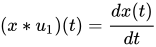
where 
The function is zero for all values except zero, where its behaviour is interesting. Its integral over any interval enclosing zero is zero. However, the integral of its absolute value over any region enclosing zero goes to infinity. The function can be thought of as the limiting case of two rectangles, one in the second quadrant, and the other in the fourth. The width of each rectangle is k, whereas the height of each is 1/k2, in the limit as k approaches zero.
Sources and credits
This article is adapted from the Wikipedia article “Unit doublet”, written by its contributors and licensed under CC BY-SA 4.0. Fathomly has changed the layout, removed citation markers, navigation and maintenance notices, and adjusted punctuation. This adapted version is shared under the same license. For references, see the original article.
Images, from Wikimedia Commons:
Fathomly is not affiliated with or endorsed by the Wikimedia Foundation. Spotted a problem? Tell us.