Unit demand
In economics, a unit demand agent is an agent who wants to buy a single item, which may be of one of different types. A typical example is a buyer who needs a new car. There are many different types of cars, but usually a buyer will choose only one of them, based on the quality and the price.
If there are m different item-types, then a unit-demand valuation function is typically represented by m values 


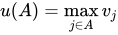
since he enjoys the most valuable item from
Therefore, if the price of item 

01Ordinal and cardinal definitions
A unit-demand valuation is formally defined by:
- For a preference relation: for every set
there is a subset
with cardinality
, such that
.
- For a utility function: For every set
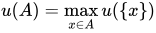
02Connection to other classes of utility functions
A unit-demand function is an extreme case of a submodular set function.
It is characteristic of items that are pure substitute goods.
Sources and credits
This article is adapted from the Wikipedia article “Unit demand”, written by its contributors and licensed under CC BY-SA 4.0. Fathomly has changed the layout, removed citation markers, navigation and maintenance notices, and adjusted punctuation. This adapted version is shared under the same license. For references, see the original article.
Fathomly is not affiliated with or endorsed by the Wikimedia Foundation. Spotted a problem? Tell us.