Ungula
Region between a revolved surface and oblique plane
In solid geometry, an ungula is a region of a solid of revolution, cut off by a plane oblique to its base. A common instance is the spherical wedge. The term ungula refers to the hoof of a horse, an anatomical feature that defines a class of mammals called ungulates.
The volume of an ungula of a cylinder was calculated by Grégoire de Saint Vincent. Two cylinders with equal radii and perpendicular axes intersect in four double ungulae. The bicylinder formed by the intersection had been measured by Archimedes in The Method of Mechanical Theorems, but the manuscript was lost until 1906.
A historian of calculus described the role of the ungula in integral calculus:
- Grégoire himself was primarily concerned to illustrate by reference to the ungula that volumetric integration could be reduced, through the ductus in planum, to a consideration of geometric relations between the lies of plane figures. The ungula, however, proved a valuable source of inspiration for those who followed him, and who saw in it a means of representing and transforming integrals in many ingenious ways.
01Cylindrical ungula
A cylindrical ungula of base radius r and height h has volume
,.
Its total surface area is
,
the surface area of its curved sidewall is
,
and the surface area of its top (slanted roof) is
.
Proof
Consider a cylinder 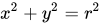


.
Cutting up the volume into slices parallel to the y-axis, then a differential slice, shaped like a triangular prism, has volume

where

is the area of a right triangle whose vertices are, 
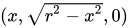




![\qquad ={1 \over 2}k{\Big (}[r^{2}x]_{-r}^{r}-{\Big [}{1 \over 3}x^{3}{\Big ]}_{-r}^{r}{\Big )}={1 \over 2}k(2r^{3}-{2 \over 3}r^{3})={2 \over 3}kr^{3}](https://wikimedia.org/api/rest_v1/media/math/render/svg/1f0c2358c4da5fdb21c02aa34d2b20b096b1a0c6)
which equals
after substituting 
A differential surface area of the curved side wall is
,
which area belongs to a nearly flat rectangle bounded by vertices 






where the integral yields ![-[\cos \theta ]_{0}^{\pi }=-[-1-1]=2](https://wikimedia.org/api/rest_v1/media/math/render/svg/15158580a2008fc222feaac419d82ec128c0b10c)
,
and substituting
The base of the cylindrical ungula has the surface area of half a circle of radius r: 


and substituting 
Note how the surface area of the side wall is related to the volume: such surface area being 


When the slope k equals 1 then such ungula is precisely one eighth of a bicylinder, whose volume is 


02Conical ungula
A conical ungula of height h, base radius r, and upper flat surface slope k (if the semicircular base is at the bottom, on the plane z = 0) has volume

where
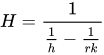
is the height of the cone from which the ungula has been cut out, and
.
The surface area of the curved sidewall is
.
As a consistency check, consider what happens when the height of the cone goes to infinity, so that the cone becomes a cylinder in the limit:

so that
,
, and
,
which results agree with the cylindrical case.
Proof
Let a cone be described by

where r and H are constants and z and ρ are variables, with

and
.
Let the cone be cut by a plane
.
Substituting this z into the cone's equation, and solving for ρ yields
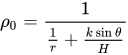
which for a given value of θ is the radial coordinate of the point common to both the plane and the cone that is farthest from the cone's axis along an angle θ from the x-axis. The cylindrical height coordinate of this point is
.
So along the direction of angle θ, a cross-section of the conical ungula looks like the triangle
.
Rotating this triangle by an angle 


The differential trapezoidal pyramid has a trapezoidal base with a length at the base (of the cone) of 
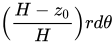
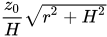
.
An altitude from the trapezoidal base to the point 
.
(This is an altitude of one of the side triangles of the trapezoidal pyramid.) The volume of the pyramid is one-third its base area times its altitudinal length, so the volume of the conical ungula is the integral of that:

where

Substituting the right hand side into the integral and doing some algebraic manipulation yields the formula for volume to be proven.
For the sidewall:

and the integral on the rightmost-hand-side simplifies to 
As a consistency check, consider what happens when k goes to infinity; then the conical ungula should become a semi-cone.
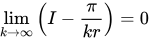

which is half of the volume of a cone.

which is half of the surface area of the curved wall of a cone.
Surface area of top part
When 
.
When 

where
,
,
,
, and
.
When 

where
,
is as above,
,
,
,
,
where the logarithm is natural, and
.

Sources and credits
This article is adapted from the Wikipedia article “Ungula”, written by its contributors and licensed under CC BY-SA 4.0. Fathomly has changed the layout, removed citation markers, navigation and maintenance notices, and adjusted punctuation. This adapted version is shared under the same license. For references, see the original article.
Images, from Wikimedia Commons:
- Cylindrical ungula.png by AugPi, CC BY 4.0
- Conical ungula.png by AugPi, CC BY 4.0
Fathomly is not affiliated with or endorsed by the Wikimedia Foundation. Spotted a problem? Tell us.

