Uncomputation
Quantum computing technique

Uncomputation is a technique, used in reversible circuits, for cleaning up temporary effects on ancilla bits so that they can be re-used.
Uncomputation is a fundamental step in quantum computing algorithms. Whether or not intermediate effects have been uncomputed affects how states interfere with each other when measuring results.
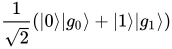
The process is primarily motivated by the principle of implicit measurement, which states that discarding a register during computation is physically equivalent to measuring it. Failure to uncompute garbage registers can have unintentional consequences. For example, if we take the state 


Sources and credits
This article is adapted from the Wikipedia article “Uncomputation”, written by its contributors and licensed under CC BY-SA 4.0. Fathomly has changed the layout, removed citation markers, navigation and maintenance notices, and adjusted punctuation. This adapted version is shared under the same license. For references, see the original article.
Images, from Wikimedia Commons:
- Using Toffoli Gates and Ancilla Bits to make a Not Gate with many controls.png by Craig Gidney, CC BY-SA 4.0
Fathomly is not affiliated with or endorsed by the Wikimedia Foundation. Spotted a problem? Tell us.