Umov effect
The Umov effect, also known as Umov's law, is a relationship between the albedo of an astronomical object, and the degree of polarization of light reflecting off it. The effect was discovered by the Russian physicist Nikolay Umov in 1905, and can be observed for celestial objects such as the surface of the Moon and the asteroids.
The degree of linear polarization of light P is defined by
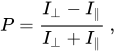
where 

Umov's law states

where α is the albedo of the object. Thus, highly reflective objects tend to reflect mostly unpolarized light, and dimly reflective objects tend to reflect polarized light. The law is only valid for large phase angles (angles between the incident light and the reflected light).
Sources and credits
This article is adapted from the Wikipedia article “Umov effect”, written by its contributors and licensed under CC BY-SA 4.0. Fathomly has changed the layout, removed citation markers, navigation and maintenance notices, and adjusted punctuation. This adapted version is shared under the same license. For references, see the original article.
Fathomly is not affiliated with or endorsed by the Wikimedia Foundation. Spotted a problem? Tell us.