Two-fluid model
Model for superfluidity and traffic
In condensed matter physics, the two-fluid model is a macroscopic model to explain superfluidity. The idea was suggested by László Tisza in 1938 and reformulated by Lev Landau in 1941 to explain the behavior of superfluid helium-4. This model states that there will be two components in liquid helium below its lambda point (the temperature where superfluid forms). These components are a normal fluid and an ideal fluid component. Each liquid has a different density and together their sum makes the total density, which remains constant. The ratio of superfluid density to the total density increases as the temperature approaches absolute zero.
01Equations
The two-fluid model can be described by a system of coupled inviscid and viscous fluid system, in the low velocity limit, the equations are given by


where the 


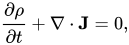
where the total flow is given by

These corresponds to a coupled Navier-Stokes equations (normal component) to Euler equations (ideal superfluid component).
02Application to traffic
There is also a two-fluid model also refers to a macroscopic traffic flow model to represent traffic in a town/city or metropolitan area, put forward in the 1970s by Ilya Prigogine and Robert Herman. It was inspired by the superfluid model.
Sources and credits
This article is adapted from the Wikipedia article “Two-fluid model”, written by its contributors and licensed under CC BY-SA 4.0. Fathomly has changed the layout, removed citation markers, navigation and maintenance notices, and adjusted punctuation. This adapted version is shared under the same license. For references, see the original article.
Fathomly is not affiliated with or endorsed by the Wikimedia Foundation. Spotted a problem? Tell us.