Truncated binary encoding
Truncated binary encoding is an entropy encoding typically used for uniform probability distributions with a finite alphabet. It is parameterized by an alphabet with total size of number n. It is a slightly more general form of binary encoding when n is not a power of two.
If n is a power of two, then the coded value for 0 ≤ x < n is the simple binary code for x of length log2(n). Otherwise let k = floor(log2(n)), such that 2k < n < 2k+1and let u = 2k+1 − n.
Truncated binary encoding assigns the first u symbols codewords of length k and then assigns the remaining n − u symbols the last n − u codewords of length k + 1. Because all the codewords of length k + 1 consist of an unassigned codeword of length k with a "0" or "1" appended, the resulting code is a prefix code.
01History
Used since at least 1984, phase-in codes, also known as economy codes, are also known as truncated binary encoding.
02Example with n = 5
For example, for the alphabet {0, 1, 2, 3, 4}, n = 5 and 22 ≤ n < 23, hence k = 2 and u = 23 − 5 = 3. Truncated binary encoding assigns the first u symbols the codewords 00, 01, and 10, all of length 2, then assigns the last n − u symbols the codewords 110 and 111, the last two codewords of length 3.
For example, if n is 5, plain binary encoding and truncated binary encoding allocates the following codewords. Digits shown struck are not transmitted in truncated binary.
| Truncated binary | Encoding | Standard binary | ||
|---|---|---|---|---|
| 0 | 0 | 0 | 0 | 0 |
| 1 | 0 | 0 | 1 | 1 |
| 2 | 0 | 1 | 0 | 2 |
| UNUSED | 0 | 1 | 1 | 3 |
| UNUSED | 1 | 0 | 0 | 4 |
| UNUSED | 1 | 0 | 1 | 5/UNUSED |
| 3 | 1 | 1 | 0 | 6/UNUSED |
| 4 | 1 | 1 | 1 | 7/UNUSED |
It takes 3 bits to encode n using straightforward binary encoding, hence 23 − n = 8 − 5 = 3 are unused.
In numerical terms, to send a value x, where 0 ≤ x < n, and where there are 2k ≤ n < 2k+1 symbols, there are u = 2k+1 − n unused entries when the alphabet size is rounded up to the nearest power of two. The process to encode the number x in truncated binary is: if x is less than u, encode it in k binary bits; if x is greater than or equal to u, encode the value x + u in k + 1 binary bits.
03Example with n = 10
Another example, encoding an alphabet of size 10 (between 0 and 9) requires 4 bits, but there are 24 − 10 = 6 unused codes, so input values less than 6 have the first bit discarded, while input values greater than or equal to 6 are offset by 6 to the end of the binary space. (Unused patterns are not shown in this table.)
| Input value | Offset | Offset value | Standard binary | Truncated binary |
|---|---|---|---|---|
| 0 | 0 | 0 | 0000 | 000 |
| 1 | 0 | 1 | 0001 | 001 |
| 2 | 0 | 2 | 0010 | 010 |
| 3 | 0 | 3 | 0011 | 011 |
| 4 | 0 | 4 | 0100 | 100 |
| 5 | 0 | 5 | 0101 | 101 |
| 6 | 6 | 12 | 0110 | 1100 |
| 7 | 6 | 13 | 0111 | 1101 |
| 8 | 6 | 14 | 1000 | 1110 |
| 9 | 6 | 15 | 1001 | 1111 |
To decode, read the first k bits. If they encode a value less than u, decoding is complete. Otherwise, read an additional bit and subtract u from the result.
04Example with n = 7
Here is a more extreme case: with n = 7 the next power of 2 is 8, so k = 2 and u = 23 − 7 = 1:
| Input value | Offset | Offset value | Standard binary | Truncated binary |
|---|---|---|---|---|
| 0 | 0 | 0 | 000 | 00 |
| 1 | 1 | 2 | 001 | 010 |
| 2 | 1 | 3 | 010 | 011 |
| 3 | 1 | 4 | 011 | 100 |
| 4 | 1 | 5 | 100 | 101 |
| 5 | 1 | 6 | 101 | 110 |
| 6 | 1 | 7 | 110 | 111 |
This last example demonstrates that a leading zero bit does not always indicate a short code; if u < 2k, some long codes will begin with a zero bit.
05Simple algorithm
Generate the truncated binary encoding for a value x, 0 ≤ x < n, where n > 0 is the size of the alphabet containing x. n need not be a power of two.
string TruncatedBinary (int x, int n) { // Set k = floor(log2(n)), i.e., k such that 2^k <= n < 2^(k+1). int k = 0, t = n; while (t > 1) { k++; t >>= 1; } // Set u to the number of unused codewords = 2^(k+1) - n. int u = (1 << k + 1) - n; if (x < u) return Binary(x, k); else return Binary(x + u, k + 1)); }The routine Binary is expository; usually just the rightmost len bits of the variable x are desired. Here we simply output the binary code for x using len bits, padding with high-order 0s if necessary.
string Binary (int x, int len) { string s = ""; while (x != 0) { if (even(x)) s = '0' + s; else s = '1' + s; x >>= 1; } while (s.Length < len) s = '0' + s; return s; }06On efficiency
If n is not a power of two, and k-bit symbols are observed with probability p, then (k + 1)-bit symbols are observed with probability 1 − p. We can calculate the expected number of bits per symbol 

Raw encoding of the symbol has 

When simplified, this expression leads to
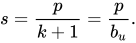
This indicates that relative efficiency of truncated binary encoding increases as probability p of k-bit symbols increases, and the raw-encoding symbol bit-length 
Sources and credits
This article is adapted from the Wikipedia article “Truncated binary encoding”, written by its contributors and licensed under CC BY-SA 4.0. Fathomly has changed the layout, removed citation markers, navigation and maintenance notices, and adjusted punctuation. This adapted version is shared under the same license. For references, see the original article.
Fathomly is not affiliated with or endorsed by the Wikimedia Foundation. Spotted a problem? Tell us.
