Triangular distribution
Probability distribution

In probability theory and statistics, the triangular distribution is a continuous probability distribution with lower limit a, upper limit b, and mode c, where a < b and a ≤ c ≤ b.
01Special cases
Mode at a bound
The distribution simplifies when c = a or c = b. For example, if a = 0, b = 1 and c = 1, then the PDF and CDF become:
![{\begin{aligned}f(x)&=2x,\\[8pt]F(x)&=x^{2}\end{aligned}}](https://wikimedia.org/api/rest_v1/media/math/render/svg/6bd343fa297be8c0f9b1577645d850cada9a24cc)

![{\begin{aligned}\operatorname {E} (X)&={\frac {2}{3}}\\[8pt]\operatorname {Var} (X)&={\frac {1}{18}}\end{aligned}}](https://wikimedia.org/api/rest_v1/media/math/render/svg/17f24b03334eae3cdacab78cc232afda9537732d)
Distribution of the absolute difference of two standard uniform variables
This distribution for a = 0, b = 1 and c = 0 is the distribution of X = |X1 − X2|, where X1, X2 are two independent random variables with standard uniform distribution.
![{\begin{aligned}f(x)&=2-2x{\text{ for }}0\leq x<1\\[6pt]F(x)&=2x-x^{2}{\text{ for }}0\leq x<1\\[6pt]E(X)&={\frac {1}{3}}\\[6pt]\operatorname {Var} (X)&={\frac {1}{18}}\end{aligned}}](https://wikimedia.org/api/rest_v1/media/math/render/svg/fe08f03f7fa58adc4c3ff145380cf294a0ce27f7)
Symmetric triangular distribution
The symmetric case arises when c = (a + b) / 2. In this case, an alternate form of the distribution function is:
![{\begin{aligned}f(x)&={\frac {(b-c)-|c-x|}{(b-c)^{2}}}\\[6pt]&={\frac {2}{b-a}}\left(1-{\frac {\left|a+b-2x\right|}{b-a}}\right)\end{aligned}}](https://wikimedia.org/api/rest_v1/media/math/render/svg/21fed7bf09409af75f760a427c24824d7716af4e)
Distribution of the mean of two standard uniform variables
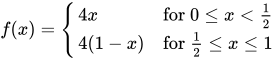
This distribution for a = 0, b = 1 and c = 0.5, the mode (i.e., the peak) is exactly in the middle of the interval, corresponds to the distribution of the mean of two standard uniform variables, that is, the distribution of X = (X1 + X2) / 2, where X1, X2 are two independent random variables with standard uniform distribution in [0, 1]. It is the case of the Bates distribution for two variables.

![{\begin{aligned}E(X)&={\frac {1}{2}}\\[6pt]\operatorname {Var} (X)&={\frac {1}{24}}\end{aligned}}](https://wikimedia.org/api/rest_v1/media/math/render/svg/30f5209e0fb7c8e67495e515b68623b00b681a2c)
02Generating random variates
Given a random variate U drawn from the uniform distribution in the interval (0, 1), then the variate

where 


03Use of the distribution
The triangular distribution is typically used as a subjective description of a population for which there is only limited sample data, and especially in cases where the relationship between variables is known but data is scarce (possibly because of the high cost of collection). It is based on a knowledge of the minimum and maximum and an "inspired guess" as to the modal value. For these reasons, the triangle distribution has been called a "lack of knowledge" distribution.
Business simulations
The triangular distribution is therefore often used in business decision making, particularly in simulations. Generally, when not much is known about the distribution of an outcome (say, only its smallest and largest values), it is possible to use the uniform distribution. But if the most likely outcome is also known, then the outcome can be simulated by a triangular distribution. See for example under corporate finance.
Project management
The triangular distribution, along with the PERT distribution, is also widely used in project management (as an input into PERT and hence critical path method (CPM)) to model events which take place within an interval defined by a minimum and maximum value.
Audio dithering
The symmetric triangular distribution is commonly used in audio dithering, where it is called TPDF (triangular probability density function).
Sources and credits
This article is adapted from the Wikipedia article “Triangular distribution”, written by its contributors and licensed under CC BY-SA 4.0. Fathomly has changed the layout, removed citation markers, navigation and maintenance notices, and adjusted punctuation. This adapted version is shared under the same license. For references, see the original article.
Images, from Wikimedia Commons:
- Triangular distribution PMF.png by Unknown author, CC BY-SA 3.0
Fathomly is not affiliated with or endorsed by the Wikimedia Foundation. Spotted a problem? Tell us.

