Tree network
Hybrid network topology

A tree topology, or star-bus topology, is a hybrid network topology in which star networks are interconnected via bus networks. Tree networks are hierarchical, and each node can have an arbitrary number of child nodes.
01Regular tree networks
A regular tree network's topology is characterized by two parameters: the branching, 


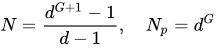
02Random tree networks
Three parameters are crucial in determining the statistics of random tree networks: first, the branching probability; second, the maximum number of allowed progenies at each branching point; and third, the maximum number of generations that a tree can attain. There are a lot of studies that address large tree networks; however, small tree networks are seldom studied.
03Tools to deal with networks
A group at MIT has developed a set of functions for Matlab that can help in analyzing networks. These tools could be used to study tree networks as well.
L. de Weck, Oliver. "MIT Strategic Engineering Research Group (SERG), Part II". Retrieved May 1, 2018.
Sources and credits
This article is adapted from the Wikipedia article “Tree network”, written by its contributors and licensed under CC BY-SA 4.0. Fathomly has changed the layout, removed citation markers, navigation and maintenance notices, and adjusted punctuation. This adapted version is shared under the same license. For references, see the original article.
Images, from Wikimedia Commons:
- TreeTopology.png by Tsingha02, CC BY-SA 4.0
Fathomly is not affiliated with or endorsed by the Wikimedia Foundation. Spotted a problem? Tell us.