Atlas (topology)
Set of charts that describes a manifold
In mathematics, particularly topology, an atlas is a concept used to describe a manifold. An atlas consists of individual charts that, roughly speaking, describe individual regions of the manifold. In general, the notion of atlas underlies the formal definition of a manifold and related structures such as vector bundles and other fiber bundles.
01Charts
The definition of an atlas depends on the notion of a chart. A chart for a topological space M is a homeomorphism 

When a coordinate system is chosen in the Euclidean space, this defines coordinates on 


02Formal definition of atlas
An atlas for a topological space 


The plural of atlas is atlases, although some authors use atlantes.
An atlas 

- The image of each chart is either
or
, where
is a locally finite open cover of
, where
is the open ball of radius 1 centered at the origin.
Every second-countable manifold admits an adequate atlas. Moreover, if 

03Transition maps
A transition map provides a way of comparing two charts of an atlas. To make this comparison, we consider the composition of one chart with the inverse of the other. This composition is not well-defined unless we restrict both charts to the intersection of their domains of definition. (For example, if we have a chart of Europe and a chart of Russia, then we can compare these two charts on their overlap, namely the European part of Russia.)
To be more precise, suppose that 



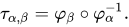
Note that since 


04More structure
One often desires more structure on a manifold than simply the topological structure. For example, if one would like an unambiguous notion of differentiation of functions on a manifold, then it is necessary to construct an atlas whose transition functions are differentiable. Such a manifold is called differentiable. Given a differentiable manifold, one can unambiguously define the notion of tangent vectors and then directional derivatives.
If each transition function is a smooth map, then the atlas is called a smooth atlas, and the manifold itself is called smooth. Alternatively, one could require that the transition maps have only k continuous derivatives in which case the atlas is said to be 
Very generally, if each transition function belongs to a pseudogroup 
Sources and credits
This article is adapted from the Wikipedia article “Atlas (topology)”, written by its contributors and licensed under CC BY-SA 4.0. Fathomly has changed the layout, removed citation markers, navigation and maintenance notices, and adjusted punctuation. This adapted version is shared under the same license. For references, see the original article.
Fathomly is not affiliated with or endorsed by the Wikimedia Foundation. Spotted a problem? Tell us.
