Transfer matrix
In wavelet theory
In applied mathematics, the transfer matrix is a formulation in terms of a block-Toeplitz matrix of the two-scale equation, which characterizes refinable functions. Refinable functions play an important role in wavelet theory and finite element theory.
For the mask 



More verbosely
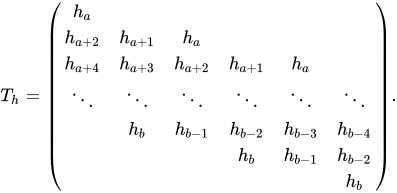
The effect of 

01Properties
.
- If you drop the first and the last column and move the odd-indexed columns to the left and the even-indexed columns to the right, then you obtain a transposed Sylvester matrix.
- The determinant of a transfer matrix is essentially a resultant.
More precisely:
Let
be the even-indexed coefficients of
) and let
be the odd-indexed coefficients of
).
Then
, where
is the resultant.
This connection allows for fast computation using the Euclidean algorithm. - For the trace of the transfer matrix of convolved masks holds
- For the determinant of the transfer matrix of convolved mask holds
wheredenotes the mask with alternating signs, i.e.
.
- If
, then
.
This is a concretion of the determinant property above. From the determinant property one knows thatis singular whenever
- If
is an eigenvector of
, i.e.
,
then
is an eigenvector of
with respect to the same eigenvalue, i.e.
.
- Let
be the eigenvalues of
and more generally
. This sum is useful for estimating the spectral radius of
.
Let
be the periodization of
. That is
it holds
Actually notconvolutions are necessary, but only
ones, when applying the strategy of efficient computation of powers. Even more the approach can be further sped up using the Fast Fourier transform.
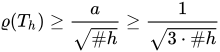
- From the previous statement we can derive an estimate of the spectral radius of
. It holds
where
is the size of the filter and if all eigenvalues are real, it is also true that
,
where.


![\mathrm {tr} (T_{h}^{n})=\left(C_{k}h*(C_{k}h\uparrow 2)*(C_{k}h\uparrow 2^{2})*\cdots *(C_{k}h\uparrow 2^{n-1})\right)_{[0]_{2^{n}-1}}](https://wikimedia.org/api/rest_v1/media/math/render/svg/777347a43e179405104b265641e40ce8f8737073)
Sources and credits
This article is adapted from the Wikipedia article “Transfer matrix”, written by its contributors and licensed under CC BY-SA 4.0. Fathomly has changed the layout, removed citation markers, navigation and maintenance notices, and adjusted punctuation. This adapted version is shared under the same license. For references, see the original article.
Fathomly is not affiliated with or endorsed by the Wikimedia Foundation. Spotted a problem? Tell us.