Total relation
Type of logical relation
In mathematics, a binary relation R ⊆ X×Y between two sets X and Y is total (or left total) if the source set X equals the domain {x : there is a y with xRy }. Conversely, R is called right total if Y equals the range {y : there is an x with xRy }.
When f: X → Y is a function, the domain of f is all of X, hence f is a total relation. On the other hand, if f is a partial function, then the domain may be a proper subset of X, in which case f is not a total relation.
"A binary relation is said to be total with respect to a universe of discourse just in case everything in that universe of discourse stands in that relation to something else."
01Algebraic characterization
Total relations can be characterized algebraically by equalities and inequalities involving compositions of relations. To this end, let 


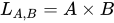





is total iff for any set
and any
implies
- If
The converse is true if
- If
The converse is true if
- If
The converse is true if
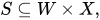
- More generally, if
and any
The converse is true if


Sources and credits
This article is adapted from the Wikipedia article “Total relation”, written by its contributors and licensed under CC BY-SA 4.0. Fathomly has changed the layout, removed citation markers, navigation and maintenance notices, and adjusted punctuation. This adapted version is shared under the same license. For references, see the original article.
Fathomly is not affiliated with or endorsed by the Wikimedia Foundation. Spotted a problem? Tell us.