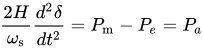
Swing equation
Differential equation in a power system
A power system consists of a number of synchronous machines operating synchronously under all operating conditions. Under normal operating conditions, the relative position of the rotor axis and the resultant magnetic field axis is fixed. The angle between the two is known as the power angle, torque angle, or rotor angle. During any disturbance, the rotor decelerates or accelerates with respect to the synchronously rotating air gap magnetomotive force, creating relative motion. The equation describing the relative motion is known as the swing equation, which is a non-linear second order differential equation that describes the swing of the rotor of synchronous machine. The power exchange between the mechanical rotor and the electrical grid due to the rotor swing (acceleration and deceleration) is called Inertial response.
01Derivation
A synchronous generator is driven by a prime mover. The equation governing the rotor motion is given by:
where:
is the total moment of inertia of the rotor mass in kg-m2
is the angular position of the rotor with respect to a stationary axis in radians (rad)
is time in seconds (s)
is the net accelerating torque, in N-m
is the mechanical torque supplied by the prime mover in N-m
is the electrical torque output of the alternator in N-m
Neglecting losses, the difference between the mechanical and electrical torque gives the net accelerating torque . In the steady state, the electrical torque is equal to the mechanical torque and hence the accelerating power is zero. During this period the rotor moves at synchronous speed
in rad/s. The electric torque
corresponds to the net air-gap power in the machine and thus accounts for the total output power of the generator plus
losses in the armature winding.
The angular position is measured with a stationary reference frame. Representing it with respect to the synchronously rotating frame gives:
where the mechanical power angle
is the angular position with respect to the synchronously rotating reference frame. The derivative of the above equation with respect to time is:
The above equations show that the rotor angular speed is equal to the synchronous speed only when
is equal to zero. Therefore, the term
represents the deviation of the rotor speed from synchronism in rad/s.
By taking the second order derivative of the above equation it becomes:
Substituting the above equation in the equation of rotor motion gives:
Multiplying both sides by the angular velocity of the rotor, given by
results in
where
,
and
respectively are the accelerating, mechanical and electrical (active) power in Watt (W). Intuitivley, the equation can also be derived by taking the time derivative of the rotational energy.
The coefficient is the angular momentum of the rotor at synchronous speed
. In machine data supplied for stability studies this coefficient is often denoted by
and called the inertia constant of the machine. In practice,
does not differ significantly from synchronous speed when the machine is in steady state
; allowing for another constant of inertia:
where
is the three phase rating of the machine in MVA. Substituting in the above equation
Since
,
and
in the machine data are given in MW, dividing them by the generator MVA rating gives these quantities in per unit. Dividing the above equation on both sides by
gives
per unit
with the electrical power angle and electrical angular velocity given by
where
is the number of poles of the synchronous machine.
The above equation describes the behaviour of the rotor dynamics and hence is known as the swing equation. The angle is that of the internal EMF
of the synchronous generator and dictates the amount of power that can be transferred. This angle is therefore called the power angle. Neglecting the machine's resistive losses, the corresponding power angle equation is:
where
is the machine reactance and
the system (i.e. grid) voltage. The angle
is also referred to as the torque angle as the electrical torque
can be derived from this equation as
Hence, for synchronous machines the swing equation is a non-linear function of
and can be solved numerically using, e.g., the fourth-order Runge-Kutta algorithm. When
is small, the equation can be linearized as
.
Sources and credits
This article is adapted from the Wikipedia article “Swing equation”, written by its contributors and licensed under CC BY-SA 4.0. Fathomly has changed the layout, removed citation markers, navigation and maintenance notices, and adjusted punctuation. This adapted version is shared under the same license. For references, see the original article.
Fathomly is not affiliated with or endorsed by the Wikimedia Foundation. Spotted a problem? Tell us.