Tensor decomposition
Process in algebra
In multilinear algebra, a tensor decomposition is any scheme for expressing a "data tensor" (M-way array) as a sequence of elementary operations acting on other, often simpler tensors. Many tensor decompositions generalize some matrix decompositions.
Tensors are generalizations of matrices to higher dimensions (or rather to higher orders, i.e. the higher number of dimensions) and can consequently be treated as multidimensional fields. The main tensor decompositions are:
01Notation
This section introduces basic notations and operations that are widely used in the field.
| Symbols | Definition |
|---|---|
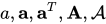 | scalar, vector, row, matrix, tensor |
 | vectorizing either a matrix or a tensor |
![{\bf {A}}_{[m]}](https://wikimedia.org/api/rest_v1/media/math/render/svg/a46c562850f437aee34eff77f06f4f5c61ffba4c) | matrixized tensor  |
 | mode-m product |
02Introduction
A multi-way graph with K perspectives is a collection of K matrices 
Sources and credits
This article is adapted from the Wikipedia article “Tensor decomposition”, written by its contributors and licensed under CC BY-SA 4.0. Fathomly has changed the layout, removed citation markers, navigation and maintenance notices, and adjusted punctuation. This adapted version is shared under the same license. For references, see the original article.
Fathomly is not affiliated with or endorsed by the Wikimedia Foundation. Spotted a problem? Tell us.