Tangential and normal components
Mathematical vector components

In mathematics, given a vector at a point on a curve, that vector can be decomposed uniquely as a sum of two vectors, one tangent to the curve, called the tangential component of the vector, and another one perpendicular to the curve, called the normal component of the vector. Similarly, a vector at a point on a surface can be broken down the same way.
More generally, given a submanifold N of a manifold M, and a vector in the tangent space to M at a point of N, it can be decomposed into the component tangent to N and the component normal to N.
01Formal definition
Surface
More formally, let 


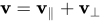
To calculate the tangential and normal components, consider a unit normal to the surface, that is, a unit vector 
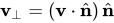
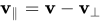


where "
These formulas do not depend on the particular unit normal
Submanifold
More generally, given a submanifold N of a manifold M and a point 


If M is a Riemannian manifold, the above sequence splits, and the tangent space of M at p decomposes as a direct sum of the component tangent to N and the component normal to N:




02Computations
Suppose N is given by non-degenerate equations.
If N is given explicitly, via parametric equations (such as a parametric curve), then the derivative gives a spanning set for the tangent bundle (it is a basis if and only if the parametrization is an immersion).
If N is given implicitly (as in the above description of a surface, (or more generally as) a hypersurface) as a level set or intersection of level surfaces for 
In both cases, we can again compute using the dot product; the cross product is special to 3 dimensions however.
03Applications
- Lagrange multipliers: constrained critical points are where the tangential component of the total derivative vanish.
- Surface normal
- Frenet-Serret formulas
- Differential geometry of surfaces § Tangent vectors and normal vectors
Sources and credits
This article is adapted from the Wikipedia article “Tangential and normal components”, written by its contributors and licensed under CC BY-SA 4.0. Fathomly has changed the layout, removed citation markers, navigation and maintenance notices, and adjusted punctuation. This adapted version is shared under the same license. For references, see the original article.
Images, from Wikimedia Commons:
- Surface normal tangent.svg by IkamusumeFan, CC BY-SA 4.0
Fathomly is not affiliated with or endorsed by the Wikimedia Foundation. Spotted a problem? Tell us.