Pushforward (differential)
Linear approximation of smooth maps on tangent spaces

In differential geometry, pushforward is a linear approximation of smooth maps (formulating manifold) on tangent spaces. Suppose that 



01Motivation
Let 



between their tangent spaces. Note the tangent spaces 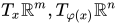
02The differential of a smooth map
Let 

from the tangent space of 


If tangent vectors are defined as equivalence classes of the curves 


Here, 


Alternatively, if tangent vectors are defined as derivations acting on smooth real-valued functions, then the differential is given by

for an arbitrary function 




After choosing two charts around 

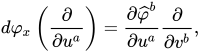
in the Einstein summation notation, where the partial derivatives are evaluated at the point in
Extending by linearity gives the following matrix
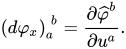
Thus the differential is a linear transformation, between tangent spaces, associated to the smooth map

The differential is frequently expressed using a variety of other notations such as

It follows from the definition that the differential of a composite is the composite of the differentials (i.e., functorial behaviour). This is the chain rule for smooth maps.
Also, the differential of a local diffeomorphism is a linear isomorphism of tangent spaces.
03The differential on the tangent bundle
The differential of a smooth map 
where 


where 


04Pushforward of vector fields
Given a smooth map φ : M → N and a vector field X on M, it is not usually possible to identify a pushforward of X by φ with some vector field Y on N. For example, if the map φ is not surjective, there is no natural way to define such a pushforward outside of the image of φ. Also, if φ is not injective there may be more than one choice of pushforward at a given point. Nevertheless, one can make this difficulty precise, using the notion of a vector field along a map.
A section of φ∗TN over M is called a vector field along φ. For example, if M is a submanifold of N and φ is the inclusion, then a vector field along φ is just a section of the tangent bundle of N along M; in particular, a vector field on M defines such a section via the inclusion of TM inside TN. This idea generalizes to arbitrary smooth maps.
Suppose that X is a vector field on M, i.e., a section of TM. Then, 
Any vector field Y on N defines a pullback section φ∗Y of φ∗TN with (φ∗Y)x = Yφ(x). A vector field X on M and a vector field Y on N are said to be φ-related if φ∗X = φ∗Y as vector fields along φ. In other words, for all x in M, dφx(X) = Yφ(x).
In some situations, given a X vector field on M, there is a unique vector field Y on N which is φ-related to X. This is true in particular when φ is a diffeomorphism. In this case, the pushforward defines a vector field Y on N, given by

A more general situation arises when φ is surjective (for example the bundle projection of a fiber bundle). Then a vector field X on M is said to be projectable if for all y in N, dφx(Xx) is independent of the choice of x in φ−1({y}). This is precisely the condition that guarantees that a pushforward of X, as a vector field on N, is well defined.
Examples
Pushforward from multiplication on Lie groups
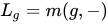
Given a Lie group 

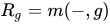









Pushforward for some Lie groups
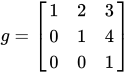
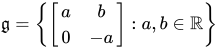
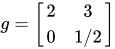
For example, if 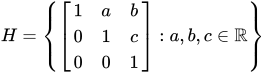






Sources and credits
This article is adapted from the Wikipedia article “Pushforward (differential)”, written by its contributors and licensed under CC BY-SA 4.0. Fathomly has changed the layout, removed citation markers, navigation and maintenance notices, and adjusted punctuation. This adapted version is shared under the same license. For references, see the original article.
Images, from Wikimedia Commons:
- Pushforward.svg by User from reddit, CC BY 3.0
Fathomly is not affiliated with or endorsed by the Wikimedia Foundation. Spotted a problem? Tell us.