Mean absolute error
Statistical error measure
In statistics, mean absolute error (MAE) is a measure of errors between paired observations expressing the same phenomenon. Examples of Y versus X include comparisons of predicted versus observed, subsequent time versus initial time, and one technique of measurement versus an alternative technique of measurement. MAE is calculated as the sum of absolute errors (i.e., the Manhattan distance) divided by the sample size:



01Quantity disagreement and allocation disagreement
In remote sensing the MAE is sometimes expressed as the sum of two components: quantity disagreement and allocation disagreement. Quantity disagreement is the absolute value of the mean error:
It is also possible to identify the types of difference by looking at an 

02Related measures
The mean absolute error is one of a number of ways of comparing forecasts with their eventual outcomes. Well-established alternatives are the mean absolute scaled error (MASE), mean absolute log error (MALE), and the mean squared error. These all summarize performance in ways that disregard the direction of over- or under- prediction; a measure that does place emphasis on this is the mean signed difference.
Where a prediction model is to be fitted using a selected performance measure, in the sense that the least squares approach is related to the mean squared error, the equivalent for mean absolute error is least absolute deviations.
MAE is not identical to root-mean square error (RMSE), although some researchers report and interpret it that way. The MAE is conceptually simpler and also easier to interpret than RMSE: it is simply the average absolute vertical or horizontal distance between each point in a scatter plot and the Y=X line. In other words, MAE is the average absolute difference between X and Y. Furthermore, each error contributes to MAE in proportion to the absolute value of the error. This is in contrast to RMSE which involves squaring the differences, so that a few large differences will increase the RMSE to a greater degree than the MAE.
Optimality property
The mean absolute error of a real variable c with respect to the random variable X is
More generally, a median is defined as a minimum of
Proof of optimality
Statement: The classifier minimising 

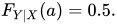
Proof:
The Loss functions for classification is![{\begin{aligned}L&=\mathbb {E} [|y-a||X=x]\\&=\int _{-\infty }^{\infty }|y-a|f_{Y|X}(y)\,dy\\&=\int _{-\infty }^{a}(a-y)f_{Y|X}(y)\,dy+\int _{a}^{\infty }(y-a)f_{Y|X}(y)\,dy.\\\end{aligned}}](https://wikimedia.org/api/rest_v1/media/math/render/svg/0a96cc05c8d685850ab7786a401cc57c9964a164)



Sources and credits
This article is adapted from the Wikipedia article “Mean absolute error”, written by its contributors and licensed under CC BY-SA 4.0. Fathomly has changed the layout, removed citation markers, navigation and maintenance notices, and adjusted punctuation. This adapted version is shared under the same license. For references, see the original article.
Images, from Wikimedia Commons:
- MAE example.png by Unknown author, CC0
Fathomly is not affiliated with or endorsed by the Wikimedia Foundation. Spotted a problem? Tell us.

