Sudan function
In the theory of computation, the Sudan function is an example of a function that is recursive, but not primitive recursive. This is also true of the better-known Ackermann function.
In 1926, David Hilbert conjectured that every computable function was primitive recursive. This was refuted by Gabriel Sudan and Wilhelm Ackermann , both his students , using different functions that were published in quick succession: Sudan in 1927, Ackermann in 1928.
The Sudan function is the earliest published example of a recursive function that is not primitive recursive.
01Definition

The last equation can be equivalently written as
.
02Computation
These equations can be used as rules of a term rewriting system (TRS).
The generalized function 

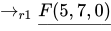
At each reduction step the rightmost innermost occurrence of F is rewritten, by application of one of the rules (r1) - (r3).
Calude (1988) gives an example: compute 
The reduction sequence is













03Value tables
Values of F0
F0(x, y) = x + y
| y \ x | 0 | 1 | 2 | 3 | 4 | 5 | 6 | 7 | 8 | 9 | 10 |
|---|---|---|---|---|---|---|---|---|---|---|---|
| 0 | 0 | 1 | 2 | 3 | 4 | 5 | 6 | 7 | 8 | 9 | 10 |
| 1 | 1 | 2 | 3 | 4 | 5 | 6 | 7 | 8 | 9 | 10 | 11 |
| 2 | 2 | 3 | 4 | 5 | 6 | 7 | 8 | 9 | 10 | 11 | 12 |
| 3 | 3 | 4 | 5 | 6 | 7 | 8 | 9 | 10 | 11 | 12 | 13 |
| 4 | 4 | 5 | 6 | 7 | 8 | 9 | 10 | 11 | 12 | 13 | 14 |
| 5 | 5 | 6 | 7 | 8 | 9 | 10 | 11 | 12 | 13 | 14 | 15 |
| 6 | 6 | 7 | 8 | 9 | 10 | 11 | 12 | 13 | 14 | 15 | 16 |
| 7 | 7 | 8 | 9 | 10 | 11 | 12 | 13 | 14 | 15 | 16 | 17 |
| 8 | 8 | 9 | 10 | 11 | 12 | 13 | 14 | 15 | 16 | 17 | 18 |
| 9 | 9 | 10 | 11 | 12 | 13 | 14 | 15 | 16 | 17 | 18 | 19 |
| 10 | 10 | 11 | 12 | 13 | 14 | 15 | 16 | 17 | 18 | 19 | 20 |
Values of F1
F1(x, y) = 2y · (x + 2) − y − 2
| y \ x | 0 | 1 | 2 | 3 | 4 | 5 | 6 | 7 | 8 | 9 | 10 |
|---|---|---|---|---|---|---|---|---|---|---|---|
| 0 | 0 | 1 | 2 | 3 | 4 | 5 | 6 | 7 | 8 | 9 | 10 |
| 1 | 1 | 3 | 5 | 7 | 9 | 11 | 13 | 15 | 17 | 19 | 21 |
| 2 | 4 | 8 | 12 | 16 | 20 | 24 | 28 | 32 | 36 | 40 | 44 |
| 3 | 11 | 19 | 27 | 35 | 43 | 51 | 59 | 67 | 75 | 83 | 91 |
| 4 | 26 | 42 | 58 | 74 | 90 | 106 | 122 | 138 | 154 | 170 | 186 |
| 5 | 57 | 89 | 121 | 153 | 185 | 217 | 249 | 281 | 313 | 345 | 377 |
| 6 | 120 | 184 | 248 | 312 | 376 | 440 | 504 | 568 | 632 | 696 | 760 |
| 7 | 247 | 375 | 503 | 631 | 759 | 887 | 1015 | 1143 | 1271 | 1399 | 1527 |
| 8 | 502 | 758 | 1014 | 1270 | 1526 | 1782 | 2038 | 2294 | 2550 | 2806 | 3062 |
| 9 | 1013 | 1525 | 2037 | 2549 | 3061 | 3573 | 4085 | 4597 | 5109 | 5621 | 6133 |
| 10 | 2036 | 3060 | 4084 | 5108 | 6132 | 7156 | 8180 | 9204 | 10228 | 11252 | 12276 |
Values of F2
| y \ x | 0 | 1 | 2 | 3 | 4 | 5 | 6 | 7 |
|---|---|---|---|---|---|---|---|---|
| 0 | 0 | 1 | 2 | 3 | 4 | 5 | 6 | 7 |
| x | ||||||||
| 1 | F1 (F2(0, 0), F2(0, 0)+1) |
F1 (F2(1, 0), F2(1, 0)+1) |
F1 (F2(2, 0), F2(2, 0)+1) |
F1 (F2(3, 0), F2(3, 0)+1) |
F1 (F2(4, 0), F2(4, 0)+1) |
F1 (F2(5, 0), F2(5, 0)+1) |
F1 (F2(6, 0), F2(6, 0)+1) |
F1 (F2(7, 0), F2(7, 0)+1) |
| F1(0, 1) | F1(1, 2) | F1(2, 3) | F1(3, 4) | F1(4, 5) | F1(5, 6) | F1(6, 7) | F1(7, 8) | |
| 1 | 8 | 27 | 74 | 185 | 440 | 1015 | 2294 | |
| 2x+1 · (x + 2) − x − 3 ≈ 10lg 2·(x+1) + lg(x+2) | ||||||||
| 2 | F1 (F2(0, 1), F2(0, 1)+2) |
F1 (F2(1, 1), F2(1, 1)+2) |
F1 (F2(2, 1), F2(2, 1)+2) |
F1 (F2(3, 1), F2(3, 1)+2) |
F1 (F2(4, 1), F2(4, 1)+2) |
F1 (F2(5, 1), F2(5, 1)+2) |
F1 (F2(6, 1), F2(6, 1)+2) |
F1 (F2(7, 1), F2(7, 1)+2) |
| F1(1, 3) | F1(8, 10) | F1(27, 29) | F1(74, 76) | F1(185, 187) | F1(440, 442) | F1(1015, 1017) | F1(2294, 2296) | |
| 19 | 10228 | 15569256417 | ≈ 5,742397643 · 1024 | ≈ 3,668181327 · 1058 | ≈ 5,019729940 · 10135 | ≈ 1,428323374 · 10309 | ≈ 3,356154368 · 10694 | |
| 22x+1·(x+2) − x − 1 · (2x+1·(x+2) − x − 1) − (2x+1·(x+2) − x + 1) ≈ 10lg 2 · (2x+1·(x+2) − x − 1) + lg(2x+1·(x+2) − x − 1) ≈ 10lg 2 · 2x+1·(x+2) + lg(2x+1·(x+2)) ≈ 10lg 2 · (2x+1·(x+2)) = 1010lg lg 2 + lg 2·(x+1) + lg(x+2) ≈ 1010lg 2·(x+1) + lg(x+2) | ||||||||
| 3 | F1 (F2(0, 2), F2(0, 2)+3) |
F1 (F2(1, 2), F2(1, 2)+3) |
F1 (F2(2, 2), F2(2, 2)+3) |
F1 (F2(3, 2), F2(3, 2)+3) |
F1 (F2(4, 2), F2(4, 2)+3) |
F1 (F2(5, 2), F2(5, 2)+3) |
F1 (F2(6, 2), F2(6, 2)+3) |
F1 (F2(7, 2), F2(7, 2)+3) |
| F1(F1(1,3), F1(1,3)+3) |
F1(F1(8,10), F1(8,10)+3) |
F1(F1(27,29), F1(27,29)+3) |
F1(F1(74,76), F1(74,76)+3) |
F1(F1(185,187), F1(185,187)+3) |
F1(F1(440,442), F1(440,442)+3) |
F1(F1(1015,1017), F1(1015,1017)+3) |
F1(F1(2294,2297), F1(2294,2297)+3) | |
| F1(19, 22) | F1(10228, 10231) | F1(15569256417, 15569256420) |
F1(≈6·1024, ≈6·1024) | F1(≈4·1058, ≈4·1058) | F1(≈5·10135, ≈5·10135) | F1(≈10309, ≈10309) | F1(≈3·10694, ≈3·10694) | |
| 88080360 | ≈ 7,04 · 103083 | ≈ 7,82 · 104686813201 | ≈ 101,72·1024 | ≈ 101,10·1058 | ≈ 101,51·10135 | ≈ 104,30·10308 | ≈ 101,01·10694 | |
| longer expression, starts with 222x+1 an, ≈ 101010lg 2·(x+1) + lg(x+2) | ||||||||
| 4 | F1 (F2(0, 3), F2(0, 3)+4) |
F1 (F2(1, 3), F2(1, 3)+4) |
F1 (F2(2, 3), F2(2, 3)+4) |
F1 (F2(3, 3), F2(3, 3)+4) |
F1 (F2(4, 3), F2(4, 3)+4) |
F1 (F2(5, 3), F2(5, 3)+4) |
F1 (F2(6, 3), F2(6, 3)+4) |
F1 (F2(7, 3), F2(7, 3)+4) |
| F1 (F1(19, 22), F1(19, 22)+4) |
F1 (F1(10228, 10231), F1(10228, 10231)+4) |
F1 (F1(15569256417, 15569256420), F1(15569256417, 15569256420)+4) |
F1 (F1(≈5,74·1024, ≈5,74·1024), F1(≈5,74·1024, ≈5,74·1024)) |
F1 (F1(≈3,67·1058, ≈3,67·1058), F1(≈3,67·1058, ≈3,67·1058)) |
F1 (F1(≈5,02·10135, ≈5,02·10135), F1(≈5,02·10135, ≈5,02·10135)) |
F1 (F1(≈1,43·10309, ≈1,43·10309), F1(≈1,43·10309, ≈1,43·10309)) |
F1 (F1(≈3,36·10694, ≈3,36·10694), F1(≈3,36·10694, ≈3,36·10694)) | |
| F1(88080360, 88080364) | F1(10230·210231−10233, 10230·210231−10229) | |||||||
| ≈ 3,5 · 1026514839 | ||||||||
| much longer expression, starts with 2222x+1 an, ≈ 10101010lg 2·(x+1) + lg(x+2) | ||||||||
Values of F3
| y \ x | 0 | 1 | 2 | 3 | 4 |
|---|---|---|---|---|---|
| 0 | 0 | 1 | 2 | 3 | 4 |
| x | |||||
| 1 | F2 (F3(0, 0), F3(0, 0)+1) |
F2 (F3(1, 0), F3(1, 0)+1) |
F2 (F3(2, 0), F3(2, 0)+1) |
F2 (F3(3, 0), F3(3, 0)+1) |
F2 (F3(4, 0), F3(4, 0)+1) |
| F2(0, 1) | F2(1, 2) | F2(2, 3) | F2(3, 4) | F2(4, 5) | |
| 1 | 10228 | ≈ 7,82 · 104686813201 | |||
| No closed expressions possible within the framework of normal mathematical notation | |||||
| 2 | F3 (F4(0, 1), F4(0, 1)+2) |
F3 (F4(1, 1), F4(1, 1)+2) |
F3 (F4(2, 1), F4(2, 1)+2) |
F3 (F4(3, 1), F4(3, 1)+2) |
F3 (F4(4, 1), F4(4, 1)+2) |
| F3 (1, 3) | F3 (10228, 10230) | F3 (≈104686813201, ≈104686813201) |
|||
| No closed expressions possible within the framework of normal mathematical notation | |||||
Sources and credits
This article is adapted from the Wikipedia article “Sudan function”, written by its contributors and licensed under CC BY-SA 4.0. Fathomly has changed the layout, removed citation markers, navigation and maintenance notices, and adjusted punctuation. This adapted version is shared under the same license. For references, see the original article.
Fathomly is not affiliated with or endorsed by the Wikimedia Foundation. Spotted a problem? Tell us.